

Easing regulations for biosimilars is lowering barriers to entry, but competition is expected to tighten around established leaders rather than shift to newcomers, industry watchers say.
As of April 8, major regulators including the U.S. Food and Drug Administration and the European Medicines Agency are revising standards to simplify biosimilar approvals, according to industry officials. The aim is to reduce the burden of large Phase 3 trials used to prove equivalence to original drugs and to rely more on analytical data such as pharmacokinetics (PK). Industry estimates put the impact at about a 25% cut in overall clinical costs and a development timeline shortened by one to two years.
South Korea is moving in the same direction. The Ministry of Food and Drug Safety has already shortened review times for new biologics and biosimilars to 295 days from 406 days and plans to reduce them further to 240 days.
Even so, lower regulatory hurdles are not expected to change who leads the market. Developing a biosimilar remains a high-difficulty business that can require up to $300 million per product and take more than five years.
Regulatory easing may encourage more companies to try entering, but few have the production facilities, quality control systems and global approval experience needed at the same time. As entry becomes easier, the advantages of incumbent players may stand out more, the industry says.
Jung Yi-su, an analyst at IBK Investment & Securities, said Celltrion and Samsung Bioepis are likely to be key beneficiaries in South Korea. He said Celltrion is moving quickly to revise Phase 3 trial plans in line with the regulatory changes, making it more likely to reflect the benefits of streamlined trials sooner.
External conditions are also favorable for Celltrion, the report said. A policy for "2027 Medicare Advantage" issued by the U.S. Centers for Medicare & Medicaid Services includes higher insurer burdens and higher patient out-of-pocket costs. That could increase preference for biosimilars over high-priced drugs. If costs tied to intravenous (IV) administration are reflected, demand could also rise for subcutaneous (SC) formulations that patients can self-administer. Celltrion's "Zymfentra" was cited as a direct beneficiary.
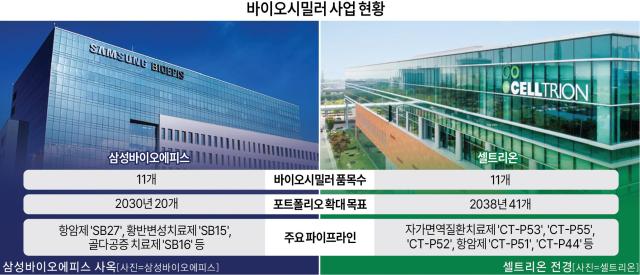
Celltrion plans to expand its biosimilar portfolio to 41 products by 2038 from 11 now. Key pipeline candidates include autoimmune disease treatments "CT-P53" and "CT-P55" and cancer treatment "CT-P51," all in Phase 3 trials.
Samsung Bioepis is viewed as ahead in developing its Keytruda biosimilar, "SB27." It completed global clinical patient enrollment earlier than competitors, raising its chances of securing an early position, the report said. U.S. biosimilar market analysis cited in the report says first movers can generate, on average, 27% higher sales than later entrants.
Keytruda patents are set to expire in the United States in 2028 and in Europe in 2031. Because clinician trust is critical, products that enter first may be able to expand share based on prescribing experience, the report said.
Samsung Bioepis has already expanded its global footprint, commercializing 11 biosimilars in more than 40 countries, including the psoriasis treatment "Pyzchiva" and the paroxysmal nocturnal hemoglobinuria treatment "Epyscli." It is developing biosimilars for seven additional blockbuster drugs nearing patent expiry and plans to expand to 20 products by 2030.
Industry officials said the regulatory shift could reshape the competitive landscape, not just expand the market. "As the clinical burden falls, more companies will try to enter the biosimilar market, but the market itself will be reorganized around existing leaders with experience and infrastructure," one industry official said.
* This article has been translated by AI.
Copyright ⓒ Aju Press All rights reserved.