

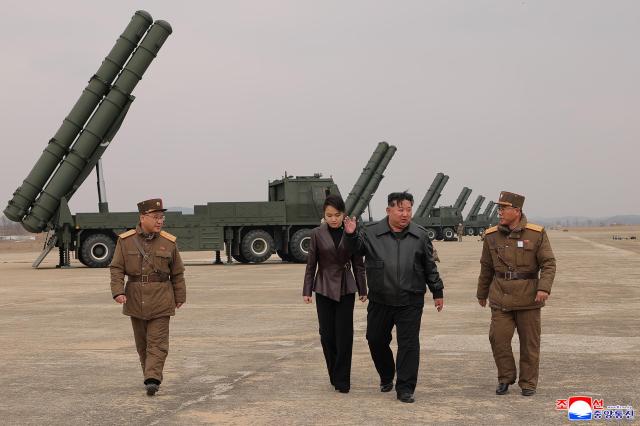
The move suggests Pyongyang may be seeking to enhance its strike capabilities by incorporating cluster payloads into its existing missile systems.
According to the state-run Korean Central News Agency (KCNA), North Korea conducted a series of weapons tests from Monday to Wednesday, including the launch of a short-range ballistic missile (SRBM) equipped with a cluster-type warhead.
The warhead was mounted on the Hwasong-11Ga, also known as KN-23, a tactical ballistic missile often compared to Russia’s Iskander system.
KCNA said the test confirmed the missile’s ability to “completely devastate” a target area of about 6.5 to 7 hectares by dispersing high-density submunitions. The area is roughly equivalent to 10 soccer fields.
The term “scatter warhead” used by North Korea refers to cluster munitions, which release multiple smaller explosives over a wide area.
South Korea’s Joint Chiefs of Staff said North Korea launched multiple SRBMs from the Wonsan area on Wednesday.
One missile, fired at around 8:50 a.m., flew about 240 kilometers before landing in waters near Al Island. Another, launched at approximately 2:20 p.m., traveled more than 700 kilometers and landed in international waters between Russia and Japan.
South Korean analysts said one of the recent tests may be linked to an unidentified projectile launched on Tuesday that appeared to fail shortly after takeoff.
North Korean leader Kim Jong-un was not reported to have attended the tests, and no related images were released.
The tests were also not featured in domestic propaganda outlets such as Rodong Sinmun or Korean Central Broadcasting.
North Korea has previously tested cluster-type warheads. In November 2022, it said it had conducted a similar test in response to the U.S.-South Korea joint air exercise “Vigilant Storm.”
Cluster munitions are widely criticized for their indiscriminate impact and long-term risks to civilians. Submunitions can fail to detonate on impact, leaving behind unexploded ordnance.
In 2008, more than 100 countries adopted the Convention on Cluster Munitions (CCM), which bans their use, production and transfer.
However, several major military powers — including the United States, China, Russia and Israel — have not joined the treaty. Neither South Korea nor North Korea are signatories.
The humanitarian impact of cluster munitions has been documented in past conflicts. During the 2006 Lebanon War, Israel reportedly used millions of submunitions, with a significant number failing to explode and causing civilian casualties in the years that followed.
Cluster munitions, sometimes referred to as “steel rain,” remain in the arsenals of several countries despite ongoing international criticism.
Copyright ⓒ Aju Press All rights reserved.
