

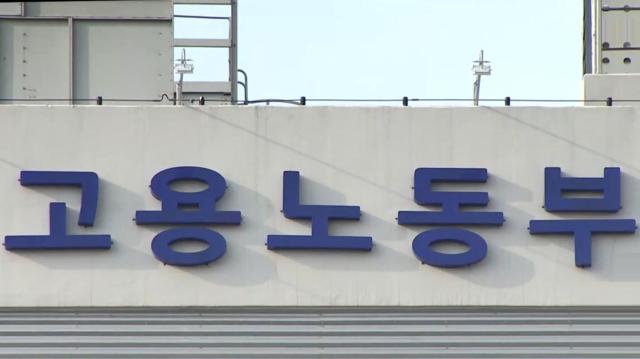
South Korea's Ministry of Employment and Labor. (Yonhap)
South Korea’s Labor Ministry said the casualties at a Cargo Truckers Solidarity rally should not be framed as an issue limited to the so-called Yellow Envelope Law, which revises Articles 2 and 3 of the Trade Union and Labor Relations Adjustment Act.
In an explanatory note released April 21 in response to reports linking the incident to the law, the ministry said it "expresses very deep regret" over the injuries and death. It said the case "goes beyond" disputes over prime contractor-subcontractor bargaining under the revised Article 2, which is based on "substantial and specific" control.
The ministry said the root problem was the lack of a structure allowing people in relatively vulnerable positions — including small business owners and individual proprietors — to organize and demand dialogue. It added it was regrettable that the conflict was not resolved through talks and instead worsened.
The ministry said it will work with relevant agencies to find ways for small merchants and self-employed people to communicate with stakeholders to protect their rights. The comments were seen as signaling a preference for creating a separate channel for talks rather than applying the Yellow Envelope Law by treating Cargo Truckers Solidarity members as small business owners or individual proprietors.
The incident occurred about 10:32 a.m. April 20 at the CU logistics center in Jinju, South Gyeongsang Province, where a 2.5-ton delivery truck collided with members of the CU branch of the Korean Public Service and Transport Workers’ Union, an affiliate of the Korean Confederation of Trade Unions. One person was killed and two others suffered serious to moderate injuries.
Cargo Truckers Solidarity has urged BGF Retail, the prime contractor, to join joint bargaining as an employer, arguing working conditions are effectively determined by the company. BGF has said it has no direct duty to bargain because convenience store logistics operate through a multilayer contract structure running from BGF Logis to logistics centers, transport firms and drivers.
The government has maintained that direct mediation is difficult because Cargo Truckers Solidarity is not an officially recognized union but an extra-legal group formed by individual business operators.
In an explanatory note released April 21 in response to reports linking the incident to the law, the ministry said it "expresses very deep regret" over the injuries and death. It said the case "goes beyond" disputes over prime contractor-subcontractor bargaining under the revised Article 2, which is based on "substantial and specific" control.
The ministry said the root problem was the lack of a structure allowing people in relatively vulnerable positions — including small business owners and individual proprietors — to organize and demand dialogue. It added it was regrettable that the conflict was not resolved through talks and instead worsened.
The ministry said it will work with relevant agencies to find ways for small merchants and self-employed people to communicate with stakeholders to protect their rights. The comments were seen as signaling a preference for creating a separate channel for talks rather than applying the Yellow Envelope Law by treating Cargo Truckers Solidarity members as small business owners or individual proprietors.
The incident occurred about 10:32 a.m. April 20 at the CU logistics center in Jinju, South Gyeongsang Province, where a 2.5-ton delivery truck collided with members of the CU branch of the Korean Public Service and Transport Workers’ Union, an affiliate of the Korean Confederation of Trade Unions. One person was killed and two others suffered serious to moderate injuries.
Cargo Truckers Solidarity has urged BGF Retail, the prime contractor, to join joint bargaining as an employer, arguing working conditions are effectively determined by the company. BGF has said it has no direct duty to bargain because convenience store logistics operate through a multilayer contract structure running from BGF Logis to logistics centers, transport firms and drivers.
The government has maintained that direct mediation is difficult because Cargo Truckers Solidarity is not an officially recognized union but an extra-legal group formed by individual business operators.
* This article has been translated by AI.
Copyright ⓒ Aju Press All rights reserved.