

Korean companies are taking a more defensive stance, choosing to repay debt rather than invest for future growth. With Middle East-driven geopolitical risks adding to interest-rate volatility, corporate profitability and financing conditions have worsened at the same time. Economists warn that a pullback by businesses could slow growth and add downward pressure across the broader economy.
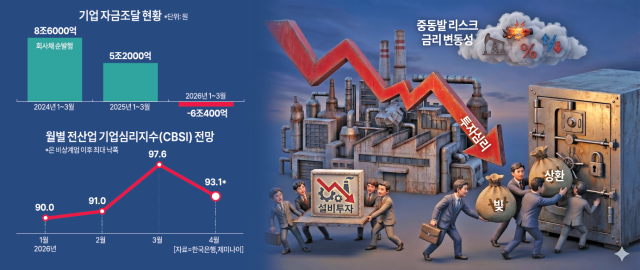
According to the Bank of Korea on April 21, the corporate bond market posted net redemptions of 6.4 trillion won from January through March. That marked a shift from net issuance in the same period in 2024 and 2025. Early in the year typically brings an “early-year effect,” when companies issue bonds to secure funding for annual business plans, helped by fresh allocations from institutional investors and relatively favorable borrowing terms.
This year, however, companies focused on paying down debt even during the usual funding window, underscoring heightened caution. The backdrop has been unpredictable external risks. Government bond yields have continued to rise this year, while war in the Middle East has pushed up international oil prices and the exchange rate, adding to cost pressures.
Markets have also priced in the possibility that the central bank could raise its policy rate to curb inflation, sending sovereign yields sharply higher. In March, the three-year government bond yield climbed to 3.617%, a move that appeared to reflect expectations of at least two rate hikes. As uncertainty has grown, companies have been prioritizing “survival” — cutting interest costs and building cash — over expansion financed by borrowing.
The concern is that this caution could weigh on the broader economy. If corporate investment falls, hiring could weaken, which could then reduce household spending and further hurt domestic demand. Restarting growth momentum once it cools can take significant time and cost.
Business indicators are already reflecting unease. The Bank of Korea said the all-industry Corporate Business Sentiment Index, or CBSI, for March slipped 0.1 point from the previous month to 94.1. The CBSI is calculated from key Business Survey Index components — five for manufacturing and four for nonmanufacturing — with 100 as the baseline; readings above 100 indicate optimism and below 100 pessimism.
April outlook readings, when the spillover from the Middle East war is expected to become more pronounced, deteriorated further. The April CBSI outlook fell 3.0 points month over month to 95.9 for manufacturing and dropped 5.6 points to 91.2 for nonmanufacturing. The declines were the steepest since January last year, following the “emergency martial law incident” in December 2024, when manufacturing fell 3.8 points and nonmanufacturing dropped 9.7 points.
Measures of profitability also weakened. The profitability BSI for March fell 3 points from the previous month to 73, and the next-month outlook (70) plunged 9 points. Sentiment on funding conditions also worsened: the funding conditions BSI edged down 1 point in March to 79, while the April outlook came in at 77, down 3 points from the prior outlook reading of 80.
Such pressure on profits and funding is likely to translate into weaker investment. The facilities investment execution BSI slipped from 95 for March’s outlook to 94 for April, signaling companies may scale back capacity expansion or new projects.
The Bank of Korea has previously said Korea’s slowing growth is rooted in weak corporate investment. Lee Jong-ung, deputy head of the BOK’s survey and research team, said, “The slowdown in growth after the economic crisis stemmed from weak investment due to deteriorating corporate profitability and the failure of self-correcting mechanisms to function smoothly,” adding, “Weak corporate investment is driven less by financing constraints than by a fundamental decline in profitability.”
* This article has been translated by AI.
Copyright ⓒ Aju Press All rights reserved.