

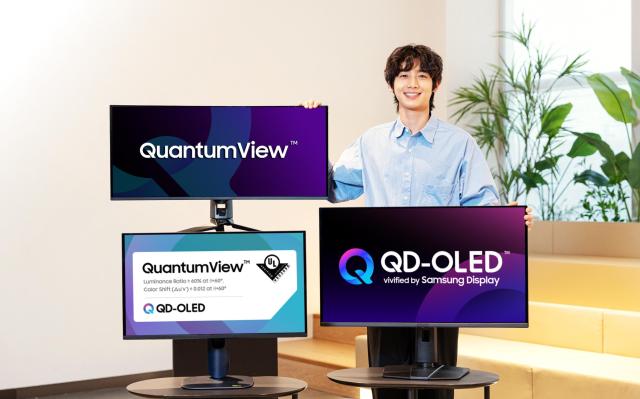
Samsung Display said Tuesday that its quantum dot OLED, or QD-OLED, panels for TVs and monitors have completed UL Solutions’ QuantumView verification, which evaluates viewing-angle performance.
QuantumView measures changes in brightness and color coordinates as the viewing position shifts from the front in 10-degree increments, up to 60 degrees off-center.
UL Solutions tested Samsung Display’s full QD-OLED lineup. At a 60-degree viewing angle, the panels maintained more than 60% of front-view brightness, while color-coordinate change was 0.012 or less, the company said.
By comparison, typical LCDs under the same 60-degree condition are known to drop to 20% or less in brightness retention, with color-coordinate change reaching up to 0.025 — about twice the shift seen in QD-OLED, Samsung Display said.
“Viewing angle has long been an important factor in choosing a TV, given living-room viewing with multiple people and consumers’ preference for larger screens,” a Samsung Display official said. The official added that demand for wide-viewing-angle QD-OLED monitors is rising as more users adopt dual or triple monitor setups, use professional reference monitors, and review shared work on a single screen.
Samsung Display attributed QD-OLED’s viewing-angle performance to its front-emission structure and the Lambertian emission characteristics of quantum-dot materials. The company said Lambertian emission refers to light being emitted uniformly in all directions, helping maintain consistent brightness regardless of viewing angle.
In QD-OLED, quantum dots absorb blue OLED light and re-emit it as red and green wavelengths, the company said, adding that the nanoscale particles also produce a Lambertian emission pattern that spreads light broadly. Samsung Display said that unlike other large-size OLED technologies, QD pixels generate clear, high-purity color directly from the front, improving both color accuracy and luminous efficiency.
Samsung Display said it is expanding its OLED monitor business beyond gaming-focused consumer markets into business-to-business segments with high demand for precision displays, including video and graphics professionals, content creators and financial traders.
The company said ASUS and Dell Technologies have recently launched creator-focused professional monitors — the ProArt and UltraSharp, respectively — using QD-OLED and have received a positive market response. Acer, Lenovo and MSI are also expected to introduce professional monitor lineups, it said.
Jeong Yong-uk, vice president and head of Samsung Display’s Strategic Marketing Team, said the QuantumView verification “objectively demonstrated” that QD-OLED can deliver consistent picture quality across different viewing environments. He said the company will work with global brands to provide what it called the best viewing experience possible from large displays, combining strong color performance with wide viewing angles.
* This article has been translated by AI.
Copyright ⓒ Aju Press All rights reserved.