

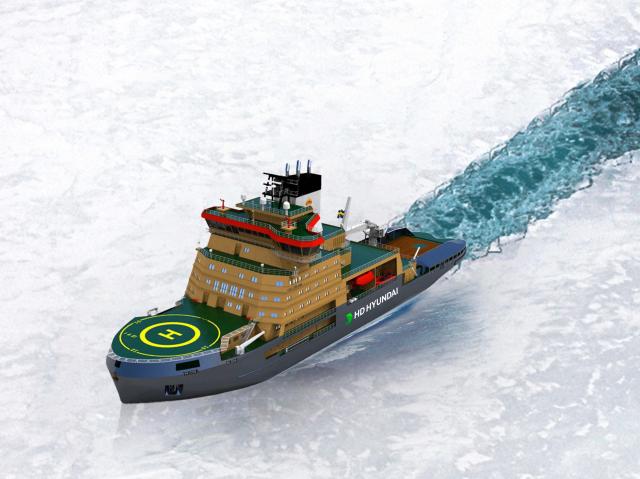
The company said it signed a contract with the Swedish Maritime Administration to build one icebreaker for $348.9 million (about 514.8 billion won).
HD Hyundai Heavy Industries said it was highly rated on price competitiveness, delivery schedule and technology. The vessel is to be delivered in 2029 and will operate in the Baltic Sea, providing icebreaking support as well as fleet operations, towing and ice management.
The company said the deal was secured amid competition with major icebreaker-building countries including Finland and Norway, marking the Korean shipbuilding industry’s entry into the global icebreaker market. It also cited public-private cooperation supported by the South Korean Embassy in Sweden and KOTRA’s Stockholm office.
Icebreakers are specialized ships designed to open routes through ice-covered waters by crushing and pushing aside sea ice, using reinforced hulls, powerful propulsion and dedicated hull designs.
The ordered vessel will be 126 meters long with a displacement of 15,000 tons and will have PC (Polar Class) 4 icebreaking capability, the company said. With an electric propulsion system, it can continuously break through ice about 1 to 1.2 meters thick.
Industry officials say commercializing Arctic routes will require not only icebreakers but also merchant ships with icebreaking capability, including LNG carriers and bulk carriers, and they view the order as a foundation for entering related markets.
Competition to secure icebreakers is also intensifying globally. The United States passed legislation last year to expand its icebreaker budget by about $9 billion, and together with Canada and Finland formed the “ICE Pact” to pursue construction of 70 to 90 vessels over the next decade.
HD Hyundai Heavy Industries said it plans to expand its special-purpose ship business based on its icebreaking technology and will also push to enter global markets for naval vessels and other special-purpose ships that require icebreaking capability.
“This icebreaker order shows our business capabilities have been recognized in the global market,” CEO Ju Won-ho said. “Based on our technology and integrated business capabilities, we will expand export markets in the special-purpose ship sector.”
* This article has been translated by AI.
Copyright ⓒ Aju Press All rights reserved.