

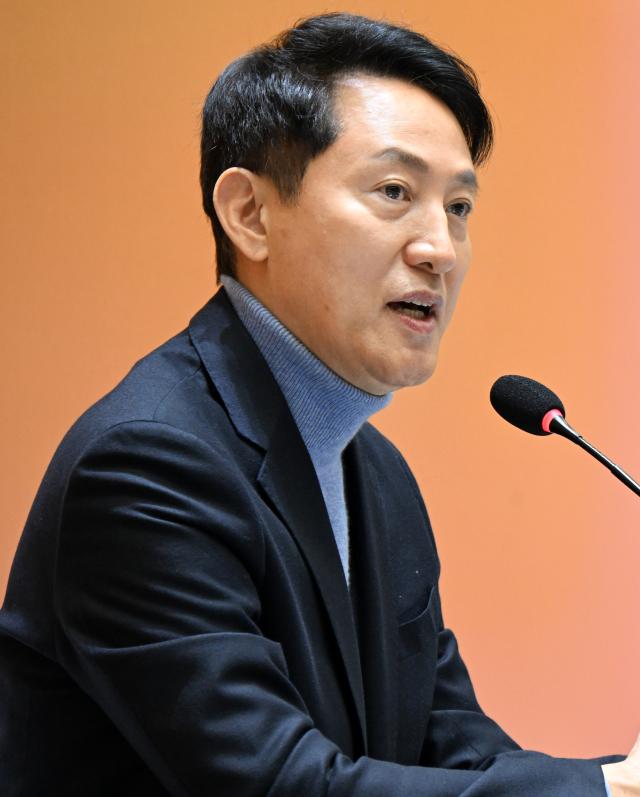
Seoul Mayor Oh Se-hoon on Thursday labeled President Lee Jae-myung a “soft dictator” and criticized him directly.
In an interview with TV Chosun released by the Seoul city government, Oh said Lee was “insulting the judiciary” while having “completely” taken control of the legislature and the executive branch. “If this continues, the separation of powers will collapse,” Oh said. “In that case, the likelihood of moving toward a ‘soft dictatorship’ is high.”
Oh said that if a government keeps the outward form of democracy while effectively monopolizing lawmaking, controlling the administration and then moving to pressure the courts, “checks and balances will inevitably be neutralized.” He added that power would then “race like a runaway locomotive with no brakes.”
Oh warned that if the Democratic Party wins by a landslide in the upcoming local elections, “that trend will accelerate,” and said “protecting Seoul” could become “the last pillar” for checking power.
-“Soft dictatorship” warning, comparisons to Russia
A soft dictatorship refers to a system in which elections and institutions remain, but power-sharing does not function in practice. It appears democratic, but legislative and executive power concentrates and the judiciary also comes under influence, undermining the balance of power. Internationally, Russian President Vladimir Putin and Turkish President Tayyip Erdogan are often cited as similar cases.
Oh described the Seoul mayoral race as more than a local contest, calling it a turning point for the national balance of power. He said results in major cities such as Seoul and Busan would shape the future power structure, adding that “protecting Seoul” was most important.
-Appeal to young voters, highlights activist and lawmaker background
Oh also highlighted his resume. A lawyer by training, he worked with the civic group Korean Federation for Environmental Movement and later served as a broadcaster and a lawmaker. As a member of the National Assembly, he led efforts to enact the Political Funds Act, known as the “Oh Se-hoon law,” and legislation to improve air quality in the Seoul metropolitan area.
He said air pollution was difficult to address without a legal framework, and that after he enacted the law, it took effect starting July 1, 2006, the day he took office as Seoul mayor. Oh said he both wrote the Seoul metropolitan air-quality law and oversaw its first implementation.
Oh said that under the law, Seoul received central government budget support and carried out measures such as emissions-reduction policies for diesel vehicles, leading to a sharp improvement in air quality. “In the past, even wearing a dress shirt for one day would turn the collar and cuffs pitch-black,” Oh said. “Now it’s fine even after two or three days.”
* This article has been translated by AI.
Copyright ⓒ Aju Press All rights reserved.