

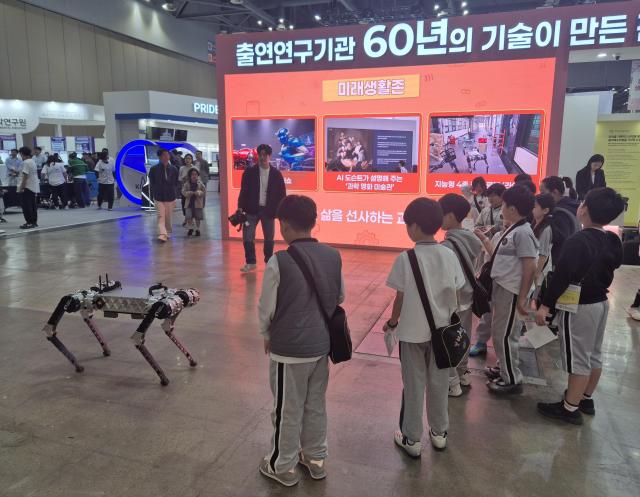
At KINTEX in Goyang, just outside Seoul, children stopped to gather around a dog-shaped robot, while a long line formed for photos in front of a boxing robot. Under the slogan, “Imagination becomes everyday life,” robots blended into a scene that no longer felt unusual.
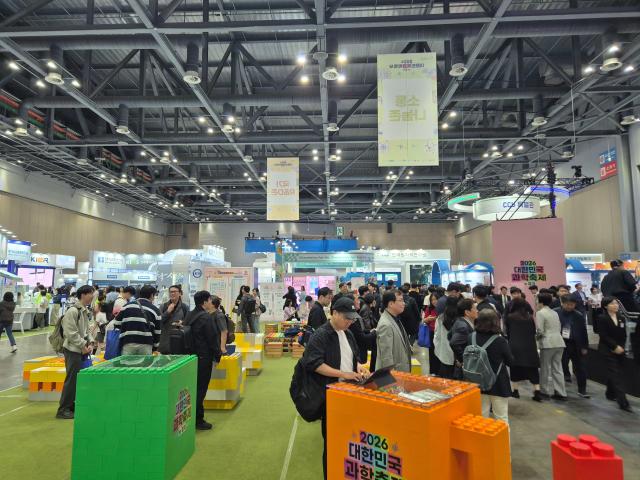
The Ministry of Science and ICT, the National Research Foundation of Korea and the Korea Foundation for the Advancement of Science and Creativity are holding the 2026 Korea Science and Technology Expo from April 24 to 26. Organizers said the event is built around four themes linking the past, present and future, and is expanding into a nationwide traveling science festival after stops in Busan and Daejeon. About 60 institutions are taking part, including 20 government-funded research institutes.
The main National R&D zone highlights ongoing research results from the institutes, with displays organized by national strategic technologies such as aviation, bio and quantum science.
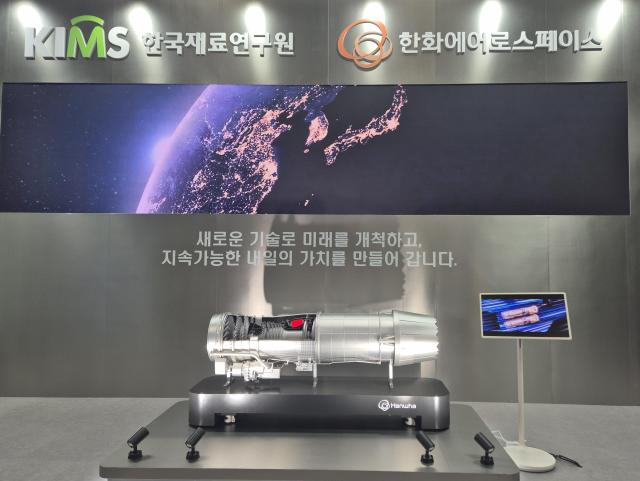
The Korea Institute of Materials Science, or KIMS, and Hanwha Aerospace set up a joint booth to present technology aimed at localizing production of key aircraft engine parts. “Aircraft engines still have a structure with a high dependence on imported parts,” a KIMS official said, adding that the institute is working with Hanwha Aerospace to localize core components.
One technology drawing attention was material for turbine blades. KIMS said it has developed a third-generation single-crystal superalloy designed to withstand high-temperature, high-pressure conditions and has entered the commercialization stage. The material is a key factor affecting engine output and efficiency, and performance verification tests are underway.
KIMS is also developing precision casting prototype production technology, aiming to complete development this year. The institute said the process improves dimensional accuracy and defect control compared with existing methods. Related work includes developing cast rotor disk materials and improving thermal barrier coating performance.
Students visiting on field trips offered immediate reactions. Cho Yun-chan, 11, from Yujeong Global School in Pocheon, Gyeonggi Province, said, “AI was fascinating, and the robot boxing was especially fun.” Another student from the school, Lee Yu-jin, also 11, said trying the robot exhibits made science more interesting and easier to understand in person.
Some exhibitors, however, said expectations were mixed with concern because the event combines a public festival with business-oriented programming, making it hard to gauge attendance. “Events for kids and business-focused events are mixed together,” one booth official said. “The key will be how many citizens come in.”
Before the expo opened, students also took part in a discussion on science and engineering career paths. Gu Hyeok-chae, first vice minister of science and ICT, met with students and answered questions on semiconductor research careers, software skills and study plans. He was reported to have emphasized the importance of strong fundamentals as AI rapidly changes the job environment.
Gu said the science festival has been expanded nationwide starting this year so more people can experience science and technology firsthand, and that after Busan and Daejeon, events will be held sequentially in places including South Jeolla Province.
“Science and technology are a core foundation that will shape South Korea’s future,” he said, pledging continued investment and expanded hands-on opportunities to broaden public engagement.
* This article has been translated by AI.
Copyright ⓒ Aju Press All rights reserved.