

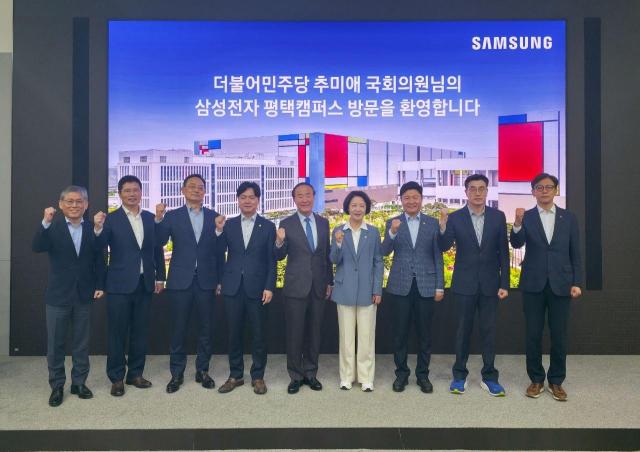
Democratic Party lawmaker Choo Mi-ae poses for a photo during her April 24 visit to Samsung Electronics’ Pyeongtaek campus. From left: Samsung Electronics President Kim Yong-kwan, President Baek Soo-hyun, President Kim Wan-pyo, Democratic Party lawmaker Kim Hyun-jung, Samsung Electronics Vice Chairman Jun Young-hyun, Democratic Party lawmaker Choo Mi-ae, Democratic Party lawmaker Hong Ki-won, Pyeongtaek mayoral candidate Choi Won-yong, and Yongin mayoral candidate Hyun Geun-taek. [Photo=Samsung Electronics]
Democratic Party lawmaker Choo Mi-ae visited Samsung Electronics’ Pyeongtaek campus on April 24, touring semiconductor production facilities and holding a meeting to discuss policy support for the chip industry, Samsung said.
Choo was joined by lawmakers Hong Ki-won and Kim Hyun-jung, as well as Pyeongtaek mayoral candidate Choi Won-yong and Yongin mayoral candidate Hyun Geun-taek. Samsung executives attending included Vice Chairman Jun Young-hyun and presidents Kim Yong-kwan, Kim Wan-pyo and Baek Soo-hyun.
Samsung said the visit was arranged to review the Pyeongtaek production lines and to discuss South Korea’s semiconductor competitiveness and directions for policy support.
Choo said the semiconductor industry cannot be built overnight, calling it a high-tech sector that depends on infrastructure such as power, water and skilled workers. She said it requires at least eight to 10 years of preparation.
With global companies already choosing southern Gyeonggi Province as an optimal location for semiconductors, Choo said the priority is to move plans forward quickly rather than shake them up. She pledged administrative and legislative support so development can continue smoothly from Pyeongtaek to the Yongin semiconductor cluster.
Jun said the semiconductor industry changes rapidly and warned that companies can fall behind if they cannot keep pace.
He said Samsung has expanded its production base from Giheung to Hwaseong to Pyeongtaek, and that the Pyeongtaek campus has grown quickly and is now largely filled. Jun called the Yongin semiconductor cluster an important project for national competitiveness, adding that if support from the government and local authorities increases, the company will respond with investment and results.
The local government candidates who attended presented semiconductor development as a key campaign pledge. They agreed on the need to build a cluster linking Pyeongtaek and Yongin to strengthen competitiveness in global supply chains.
Samsung’s Pyeongtaek campus is regarded as one of the world’s largest semiconductor production hubs by single complex. The company said it serves as a global base for key memory chips and advanced process technologies for the AI era, supported by large-scale power and water infrastructure and a concentration of skilled workers.
* This article has been translated by AI.
Copyright ⓒ Aju Press All rights reserved.