

With a Samsung Electronics union warning it may strike next month, an academic has cautioned that the bigger risk may be not the immediate production hit but the possibility that global customers shift orders and reshape supply chains.
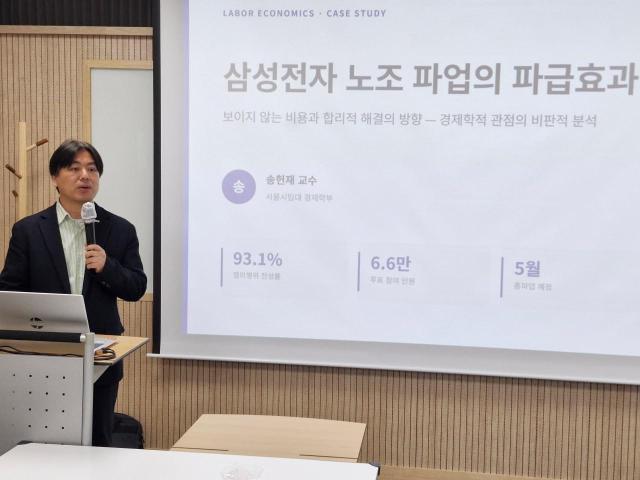
According to industry officials on the 26th, Song Heon-jae, a professor in the economics department at the University of Seoul, presented the analysis in a recent seminar held by the Anmin Policy Forum under the topic “The ripple effects of a Samsung Electronics union strike.” The Anmin Policy Forum is a private policy research forum chaired by Yoo Il-ho.
Song estimated that if semiconductor fabs stop running, losses could reach tens of billions of won per minute, or about 1 trillion won per day. If a strike drags on, he said, the decline in operating profit in the semiconductor business could widen to as much as 10 trillion won.
He said the more serious issue is weakened customer confidence and the risk of losing clients. Global big tech companies could diversify supply to competitors such as TSMC to reduce supply-chain risk, he said.
“The semiconductor industry is structured so that process qualification requires enormous time and cost,” Song said. “Once a customer leaves the supply chain, it is not easy to bring them back.”
Major global companies, he said, treat supply stability as a core evaluation standard. AMD reflects supply-chain resilience in ESG assessments, and NVIDIA is known to use supplier evaluation results when allocating volumes.
Song divided strike-related costs into “visible costs,” such as halted production and lost sales, and “invisible costs,” such as eroded trust, delayed investment and shocks to the industrial ecosystem. He said the latter could weaken market standing and undermine industrial competitiveness.
He listed key risks as weakened customer trust, permanent loss of market share, delays in AI semiconductor competition, an outflow of key talent and a deepening “Korea discount.”
He also said a strike could ripple through suppliers and local economies. About 1,700 materials, parts and equipment suppliers that do business with Samsung Electronics could be affected directly or indirectly, and a production halt at the Pyeongtaek campus could add pressure on jobs and nearby businesses.
Song pointed to opaque performance-bonus criteria and information asymmetry as factors behind the dispute. He recommended overhauling compensation based on objective management indicators, adding external verification mechanisms and institutionalizing pre-strike mediation procedures.
“With competition in AI semiconductors intensifying, a prolonged internal conflict itself can be a significant opportunity cost,” he said.
* This article has been translated by AI.
Copyright ⓒ Aju Press All rights reserved.