

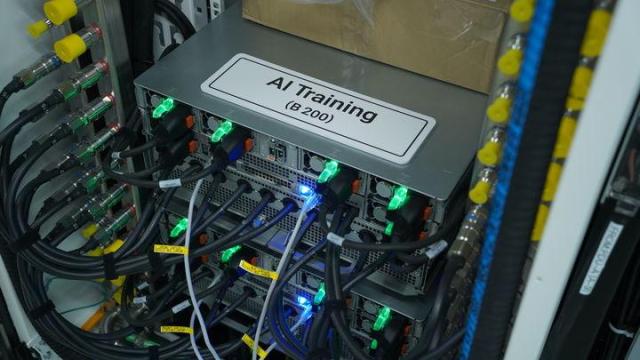
Competition is intensifying among major companies for the government’s 2.08 trillion won project to secure advanced graphics processing units, with the ability to build large clusters, whether to adopt Nvidia’s next-generation “Vera Rubin” platform, and how much of the GPUs bidders plan to use themselves emerging as key factors.
Yonhap News reported on Saturday that the National IT Industry Promotion Agency (NIPA) plans to select operators next month for the “GPU procurement, buildout and operations support” project. Led by the Ministry of Science and ICT, the initiative aims to quickly secure large-scale GPUs through public-private cooperation and supply them to domestic industry, universities and research institutes.
The project centers on using government funds to secure about 15,000 of the latest GPUs and choosing private cloud providers to build and run them reliably. Five companies submitted bids: Naver Cloud, KT Cloud, Samsung SDS, Coupang and Elice Group.
Industry officials expect multiple operators could be chosen again, as in last year’s 1.4 trillion won program, which selected Naver Cloud, Kakao and NHN Cloud.
A central issue this time is how the GPU volume will be allocated. Last year, based on proposed scale and build capability, NHN Cloud received about 8,000 units, Naver Cloud about 3,000 and Kakao about 2,400, with NHN Cloud winning the largest share after its large-cluster plan scored highly.
Cluster size remains a major evaluation item. The government requires at least one cluster of 256 nodes, or 2,048 GPUs, or more, because larger clusters significantly improve processing speed and efficiency.
Another new variable is whether bidders will adopt Nvidia’s “Vera Rubin” platform. The government plans to award extra points to proposals that include it. Naver Cloud and Elice Group are reported to be reviewing adoption, while some companies are said to have excluded it.
Vera Rubin’s high power density and facility load requirements could limit where it can be deployed, raising concerns that adoption will depend heavily on each company’s data-center infrastructure. Strategies also differ, with some proposing to use existing data centers for large GPU clusters and others promoting new approaches such as modular data centers.
How much of the GPUs companies plan to use themselves is also seen as decisive. The government will purchase and retain ownership of the GPUs, but participating companies may use the remainder after meeting public supply requirements.
Because the government gives extra points to bidders offering a higher share for public supply, companies must balance profitability against evaluation scores. Industry sources said last year’s participants set self-use at about 20%, limiting profitability.
“Once you factor in adopting a next-generation platform, the investment burden rises sharply,” an industry official said. “It’s not an environment where it’s easy to make aggressive large-scale proposals.”
* This article has been translated by AI.
Copyright ⓒ Aju Press All rights reserved.