

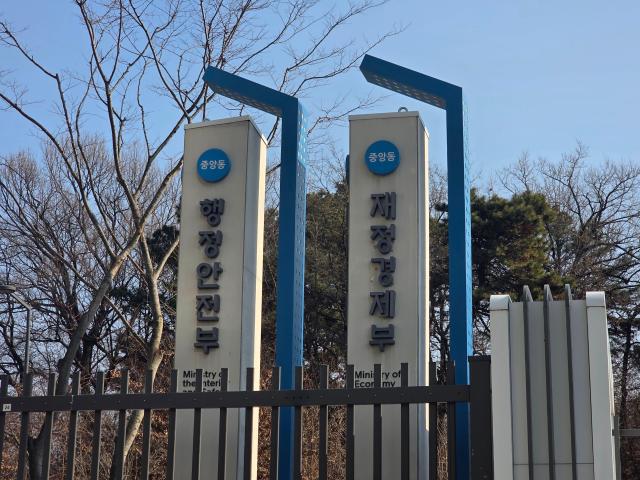
[Photo by reporter Kim Yu-jin]
The government has begun reviewing risks and preparing responses to recent shifts in the international order, including instability in the Middle East.
The Ministry of Economy and Finance said Sunday that it held a meeting with external-economy experts on April 24 at the Government Complex Seoul to discuss economic risks stemming from changes in global conditions and possible policy responses.
The session was convened to consider steps to address external uncertainties such as geopolitical tensions in the Middle East, growing supply chain uncertainty and the spread of protectionism.
Participants said the Middle East situation has underscored the importance of energy security, calling for diversification of energy supply chains alongside a transition to cleaner energy. They also agreed that policy responses must be flexible and swift.
With protectionism spreading and supply chain restructuring accelerating, participants also raised the need to secure key supply chains more reliably and strengthen strategic economic cooperation. They urged expanding cooperation with technologically advanced countries in advanced technology and strategic industries, and pursuing export and supply chain diversification to reduce dependence on specific regions.
They also warned that geopolitical risks could shrink overseas construction markets, and said the government should set up a preemptive support system while strategically using future opportunities.
Vice Minister Heo Jang said it is important to pursue a balanced approach between managing external risks and preparing mid- to long-term responses. “Based on the discussions at this meeting, we will make our policy direction more concrete and continue communication with the field,” he said.
The Ministry of Economy and Finance said Sunday that it held a meeting with external-economy experts on April 24 at the Government Complex Seoul to discuss economic risks stemming from changes in global conditions and possible policy responses.
The session was convened to consider steps to address external uncertainties such as geopolitical tensions in the Middle East, growing supply chain uncertainty and the spread of protectionism.
Participants said the Middle East situation has underscored the importance of energy security, calling for diversification of energy supply chains alongside a transition to cleaner energy. They also agreed that policy responses must be flexible and swift.
With protectionism spreading and supply chain restructuring accelerating, participants also raised the need to secure key supply chains more reliably and strengthen strategic economic cooperation. They urged expanding cooperation with technologically advanced countries in advanced technology and strategic industries, and pursuing export and supply chain diversification to reduce dependence on specific regions.
They also warned that geopolitical risks could shrink overseas construction markets, and said the government should set up a preemptive support system while strategically using future opportunities.
Vice Minister Heo Jang said it is important to pursue a balanced approach between managing external risks and preparing mid- to long-term responses. “Based on the discussions at this meeting, we will make our policy direction more concrete and continue communication with the field,” he said.
* This article has been translated by AI.
Copyright ⓒ Aju Press All rights reserved.