

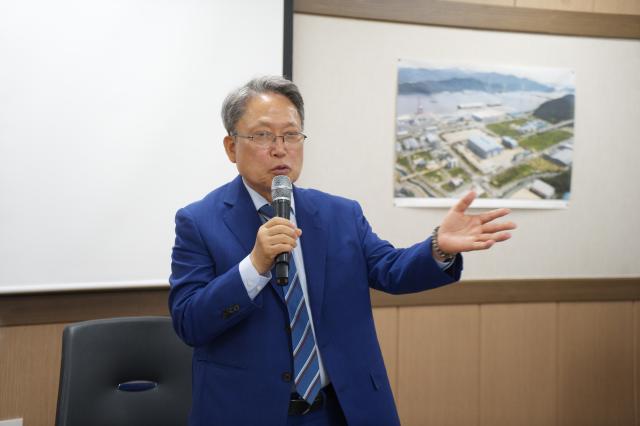
"We will go beyond distributing ship supplies and become a global marine technology group representing South Korea," Kim Myeong-jin, CEO of Maeil Marine and chairman of the Maeilbiz Association, said at a press briefing on April 23 at the company’s plant in Changwon, South Gyeongsang Province.
Kim said the company is shifting from a ship-services business to a broader marine technology company spanning manufacturing, renewable energy, defense and nuclear-related fields.
Founded in 1995, Maeil Marine grew on its ship-supply business and has become a top-tier player with 30 billion won in revenue and about 50 employees, the company said.
Kim said Maeil Marine strengthened its position through mergers and acquisitions and rebranded as Maeil Marine Partners. Starting with the 2018 acquisition of Sehwa Machinery, the company secured precision machining capabilities and localized production of key ship components such as turbochargers. In 2020, it merged SAS into its plant business division to build an environment for producing shipbuilding and onshore and offshore power-generation plants. In 2025, it acquired Samyang Trading to build logistics infrastructure linking Northeast Asia.
Kim said Maeil Marine plans to combine advanced-materials technology from affiliate Maeil Ceracam with its ship-services know-how to build an end-to-end value chain, from manufacturing ship engine parts and fabricating structures to distributing ship supplies.
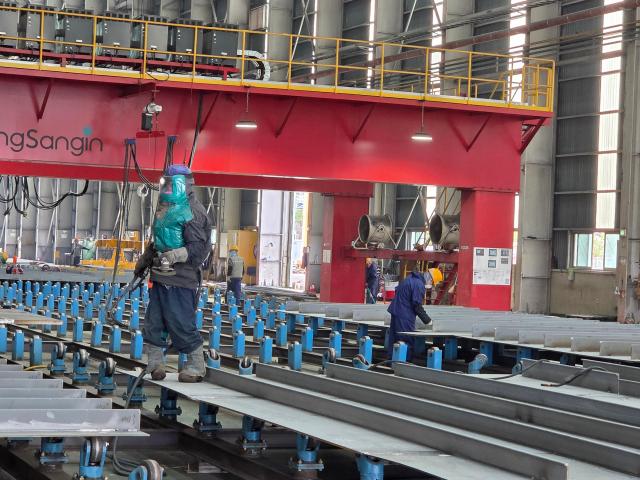
A tour of the Changwon production site ahead of the briefing highlighted Maeil Ceracam’s core technology: an advanced material that the company said maintains Level III-A ballistic protection while also withstanding temperatures of 1,100 degrees Celsius for more than four hours. The material is expected to be used in special-purpose ship structures, as well as in the defense industry and high-spec construction markets, the company said.
Kim said the company is also developing electromagnetic shielding and radiation-shielding coating technology for stealth applications, targeting higher-value markets such as naval vessels, military vehicles, and nuclear and security facilities.
"If we focused on distributing ship supplies in the past, we are now putting all our efforts into manufacturing for offshore wind plants and developing future technologies such as ship drones," Kim said. He said diversification would create new market value of 1 trillion won a year.
"Based on our distribution and manufacturing know-how, we will change the landscape of the global marine industry through an integrated value chain that links shipbuilding and defense," he said.
* This article has been translated by AI.
Copyright ⓒ Aju Press All rights reserved.