

Hanwha Aerospace said it is laying groundwork to export Korean-made air-launched weapons by developing a homegrown counterpart to the propulsion technology used in Europe’s Meteor long-range air-to-air missile.
The company said it aims to reduce heavy reliance on overseas suppliers in air-weapon technologies, strengthen South Korea’s self-reliant defense capabilities and improve export competitiveness for domestically developed fighters such as the KF-21.
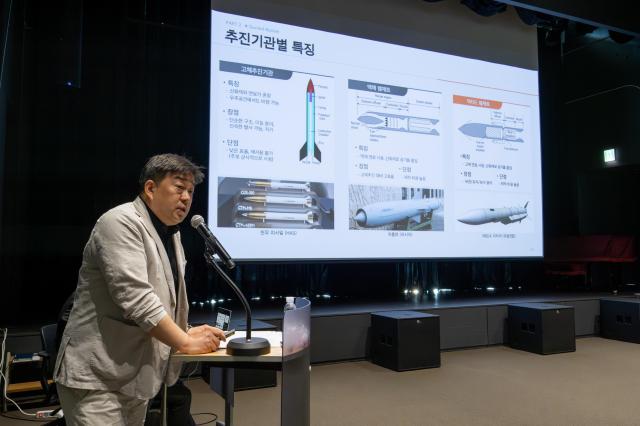
Hanwha Aerospace on April 29 held its “Hanwha Tech Academy 2026” event at Hanwha Building in Jung-gu, Seoul, and disclosed key capabilities tied to localizing air-launched weapons.
The company highlighted development status and plans centered on a ducted-ramjet propulsion system, a core technology for advanced air weapons. A ducted ramjet generates thrust by burning solid fuel using air taken in during flight.
Because it does not carry a separate oxidizer, it can load more fuel, extending range and enabling rapid acceleration and sustained high speed, the company said. The technology is widely reported to be used in MBDA’s Meteor missile. Meteor is described as flying at up to Mach 4 and intercepting aircraft beyond about 200 kilometers.
Hanwha Aerospace said the importance of long-range air weapons has grown as integrated air defense networks have drawn greater attention in conflicts such as the Russia-Ukraine war and fighting in the Middle East, increasing demand for precision strikes from outside an adversary’s engagement range. Industry officials expect export competitiveness to improve if domestically developed air weapons are integrated on Korean fighters such as the KF-21 and sold as a package.
Hanwha Aerospace said it has conducted research since 2005 with the Agency for Defense Development on key ducted-ramjet technologies, including propellants, gas generators and combustors. Based on that work, it plans to complete localization by 2033 under a government-led air-weapon program and begin mass production in 2036.
Cho Jeong-tae, propulsion development team leader in Hanwha Aerospace’s PGM business division, said the company has built localization capabilities for key components including a nozzleless booster, gas generator and rocket propellants through 20 years of research with the defense research agency.
“Especially, the oxidizer, which is core to missile propulsion, can be produced in Korea only by Hanwha,” Cho said. “As we also have the country’s largest propellant and propulsion-system manufacturing facilities, we will strengthen export competitiveness in the global fighter market through package technology development.”
Hanwha Aerospace also introduced advanced artillery-shell technologies aimed at improving accuracy for 155mm rounds used by the K9 self-propelled howitzer. Precision-guided shells are described as intelligent munitions that can strike key enemy facilities accurately with fewer rounds.
The company said the shells incorporate a combined navigation unit using GPS and an inertial navigation system, along with guidance and control equipment and tail fins.
While conventional self-propelled artillery is optimized for area fire using large volumes of rounds, pairing it with precision-guided shells can enable point strikes similar to missiles, the company said.
Hanwha Aerospace also presented a trajectory-correction fuze that uses GPS to adjust a shell’s flight path and improve accuracy. The company said the technology can address declining accuracy at longer ranges and can be used by replacing the fuze on existing ammunition.
Both the precision-guided shell and the trajectory-correction fuze include advanced anti-jamming functions developed with domestic technology to counter enemy electronic interference, the company said.
If localization of the advanced shell technologies succeeds, the company said it would allow rapid responses to changes in military requirements and could enable additional ammunition exports to countries that have adopted the K9.
A Hanwha Aerospace official said the company will “actively participate in localizing advanced defense technologies based on cooperation with the government and partner companies,” contributing to self-reliant defense and expanded exports of South Korea’s defense industry.
* This article has been translated by AI.
Copyright ⓒ Aju Press All rights reserved.