

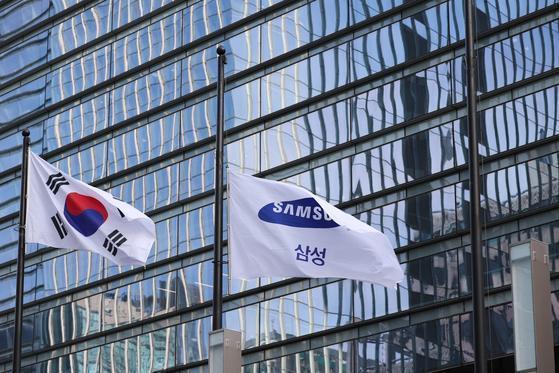
Samsung Electronics said it posted its best-ever quarterly results in the first quarter of 2026, driven overwhelmingly by semiconductors, underscoring a widening gap between its chip business and its device operations.
The company said Thursday that on a consolidated basis it recorded revenue of 133.9 trillion won and operating profit of 57.2 trillion won. Revenue rose 43% from the previous quarter and operating profit jumped 185%, setting a record for a single quarter.
The Device Solutions (DS) semiconductor division led the surge, posting revenue of 81.7 trillion won and operating profit of 53.7 trillion won, accounting for most of the company’s earnings. Samsung cited expanding AI adoption, which boosted demand for high-value memory and lifted prices. It said it strengthened technology leadership through mass production of HBM4 and next-generation low-power memory modules, and development of PCIe Gen6 SSDs.
Within chips, System LSI improved somewhat on higher flagship chip sales, while foundry results declined due to seasonal weakness. Samsung said it maintained its longer-term footing with orders centered on high-performance computing and progress in securing silicon photonics-based capabilities.
The Device eXperience (DX) set business saw higher sales but limited profit improvement. DX posted revenue of 52.7 trillion won and operating profit of 3.0 trillion won. The Mobile eXperience (MX) unit grew on stronger flagship sales, including the Galaxy S26 Ultra, but gains were constrained by rising costs and tariff burdens, the company said.
The network business weakened as telecom operators cut investment, and home appliances saw only limited improvement despite new product launches because of cost pressures. TV (VD) profitability improved somewhat on premium products, but not enough to drive overall results.
Other businesses were mixed. Harman posted revenue of 3.8 trillion won and operating profit of 200 billion won, with results falling on memory supply constraints and an off-season in the audio market. Display recorded revenue of 6.7 trillion won and operating profit of 400 billion won; small and mid-sized panels were weak on softer demand, while large OLED remained relatively steady.
Samsung said a weaker won helped results, estimating about 1.8 trillion won in profit improvement from the stronger dollar.
Looking to the second quarter, Samsung said the chip-led improvement is expected to continue. “With expanded investment in AI infrastructure, the upward trend in memory prices is expected to continue,” the company said, adding it expects profitability to improve. It said the set business is likely to remain volatile as the impact of new model launches fades and cost burdens persist.
For the second half, Samsung forecast a “conflicting environment” in which tariff and geopolitical risks and rising costs persist even as semiconductor demand increases and IT demand slows. The company said it will focus on higher value-added products and cost efficiency to protect profitability.
* This article has been translated by AI.
Copyright ⓒ Aju Press All rights reserved.