

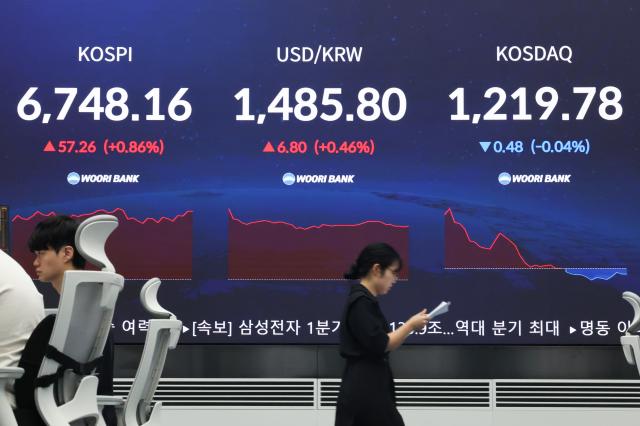
The South Korean won opened weaker against the U.S. dollar on worries that energy supply disruptions tied to the Middle East could last longer than expected.
As of 9:31 a.m. on April 30, the won was trading at 1,484.6 per dollar. It opened at 1,486.5, up 7.5 won from the previous session’s close.
The move was attributed to rising demand for safe-haven assets as ceasefire talks between the United States and Iran remained stalled, fueling concerns over prolonged supply turmoil.
Overnight, ICE Futures Europe said June Brent crude settled at $118.03 a barrel, up 6.1% from the prior session. Brent climbed as high as $119.76 intraday, its highest level since June 2022, about four years ago.
On the New York Mercantile Exchange, June West Texas Intermediate crude settled at $106.88 a barrel, up 6.95%.
U.S. stocks finished mixed as expectations for big tech earnings offset supply concerns. The Dow Jones Industrial Average fell 280.12 points, or 0.57%, to 48,861.81. The S&P 500 slipped 2.85 points, or 0.04%, to 7,135.95, while the Nasdaq composite rose 9.44 points, or 0.04%, to 24,673.24.
Min Kyung-won, an economist at Woori Bank, said the won-dollar rate was likely to rise around 1,490 as higher oil prices and weaker risk appetite follow difficulties in U.S.-Iran negotiations. With WTI above $100 a barrel, he said, oil prices are a direct burden on the won.
* This article has been translated by AI.
Copyright ⓒ Aju Press All rights reserved.