

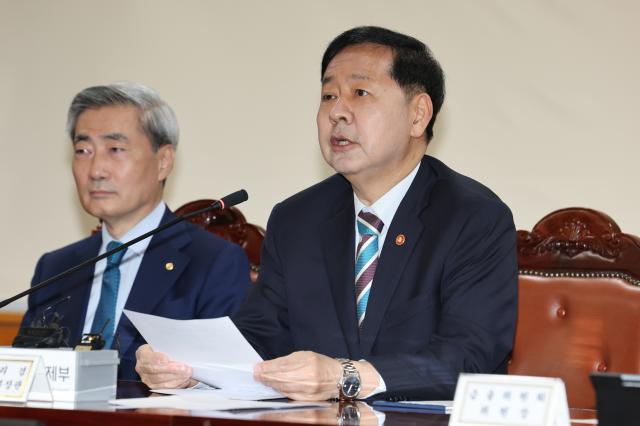
Deputy Prime Minister and Minister of Economy and Finance Koo Yun-cheol said Wednesday that volatility in financial and foreign-exchange markets is persisting, but the financial sector has sufficient capacity to respond.
Koo made the remarks at a joint “expanded macroeconomic and financial meeting” at the Korea Federation of Banks building in Seoul, where officials reviewed global market moves following the U.S. Federal Open Market Committee’s decision and assessed the impact of the Middle East war on financial and FX markets. Attendees included Bank of Korea Gov. Rhee Chang-yong, Financial Services Commission Chairman Lee Eok-won and Financial Supervisory Service Chairman Lee Chan-jin.
“Our economy is seeing stronger growth in the first quarter even amid the fallout from the Middle East war, and the KOSPI is above its prewar level,” Koo said. “However, volatility in financial and FX markets, including government bond yields and the exchange rate, continues.”
The three-year government bond yield rose to 3.627% at the end of March from 3.030% at the end of February, then moved to 3.525% the following month. The 10-year yield climbed to 3.882% from 3.447% before easing to 3.843%. Over the same period, the won-dollar exchange rate swung from 1,439.7 won to 1,530.1 won, then to 1,479.0 won.
Koo said stress tests of financial institutions showed their buffers remained adequate even in crisis scenarios involving key variables such as oil prices and the exchange rate.
Still, he warned that risks remain as uncertainty persists, including stalled ceasefire talks in the Middle East war. He cited downside risks to growth, rising inflation pressure and potential supply-chain disruptions, and said authorities will keep a 24-hour market monitoring system running and take stabilization steps in a timely manner in coordination with relevant agencies if needed.
Koo also said the government will closely track profitability risks tied to raw-material supply instability in sectors sensitive to the war, including refining, petrochemicals and construction, and expand support through financial policy measures. He noted international oil prices are surging again, with Brent crude hitting a four-year high as concerns grow over prolonged supply disruptions.
He said efforts to improve financial and FX markets will continue, including close cooperation with financial institutions to proceed smoothly with a 24-hour FX trading market and the creation of an offshore won settlement system. He also pledged to accelerate structural reforms such as internationalizing the won and revitalizing capital markets.
Koo said preparations are underway to launch a public-participation National Growth Fund in May, including quickly completing revisions to an enforcement decree to provide tax support and broaden the base for productive finance.
Participants congratulated Shin Hyun-song on his inauguration as governor and agreed to tighten policy coordination among the government, the central bank and financial regulators. They also decided to review ways to develop cooperation and communication channels for discussing macroprudential and financial issues.
* This article has been translated by AI.
Copyright ⓒ Aju Press All rights reserved.