

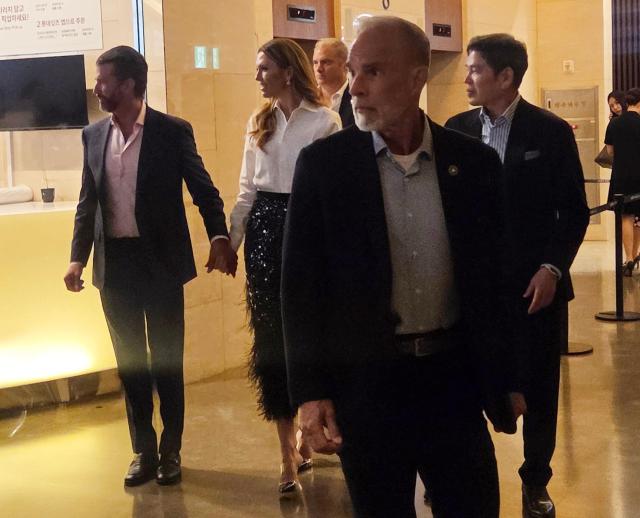
A striking scene unfolded at a concert hall in Seoul: Donald Trump Jr., the son of U.S. President Donald Trump, arrived and was greeted by Chung Yong-jin, chairman of South Korea’s Shinsegae Group. The two smiled and exchanged greetings, and red hats bearing the words “MAGA” appeared in the crowd. What looked like a simple night at a performance was widely read as something more — business.
Corporate competition has changed. In the past, making a good product at the right price could be enough. Now, with tougher rivals and faster technological shifts, who a company knows can also become a competitive asset.
Globally, companies have long used political connections to expand. The article cites Elon Musk as an example of benefiting from government support policies and regulatory easing in the electric-vehicle business, and Walmart as a company that worked with local politicians to broaden its market.
But there is a key difference: those cases involved ties within a company’s own country. Shinsegae is a Korean company, yet it is seeking links to U.S. political networks. That could create opportunity, but it can also be unstable because another country’s political environment can shift quickly.
Shinsegae’s business direction is also drawing attention. The group is best known for retail — department stores and big-box marts — but it has recently been linked to talk of advanced industries such as AI and data centers, prompting questions about why a retailer is moving in that direction.
Retail, however, has changed. Success increasingly depends on collecting and using customer data — what people buy, when they buy it and which brands they prefer. AI can analyze that data to recommend products and help run logistics more efficiently.
From that perspective, expanding from retail into AI can be a natural step. The issue is speed and method. A company can build capabilities gradually in-house, or enter quickly by leaning on outside networks. The article says Shinsegae’s approach appears closer to the latter, a faster strategy that also increases risk.
The most controversial element of the concert scene was the “MAGA” hat. The article notes it is not just a fashion item but a strong symbol of a specific political camp in U.S. politics, something companies typically handle cautiously. Businesses often try to remain politically neutral to appeal to a broad customer base.
In this case, the optics appeared to stray from that neutrality. Even if that was not the intent, the market may interpret it as a signal of alignment rather than mere personal familiarity.
The article argues the approach is not automatically wrong. It can speed access to investment or partnership opportunities through key contacts and raise a company’s profile in global markets.
But the risks are also significant. If political conditions change, the value of those ties can fade. A political image can trigger consumer backlash. And if a new venture is weakly connected to the core business, it can lose direction.
What matters, the article says, is not simply using connections but designing a strategy: clearly link AI investment to stronger retail competitiveness; avoid relying on a single side by building diverse relationships; manage corporate image by separating political ties from the brand; and build a business structure that can withstand shifting conditions.
Chung’s move, the article concludes, signals a push by Korean companies to seek opportunities through global networks rather than staying focused only on the domestic market. Connections may open doors, but lasting success still depends on performance. Whether this becomes a one-off event or a new growth strategy for Shinsegae remains unclear, and the outcome will depend on execution.
In the end, the article says, a company may start with relationships, but it must prove itself with results — not just publicity, but what comes next.
* This article has been translated by AI.
Copyright ⓒ Aju Press All rights reserved.