

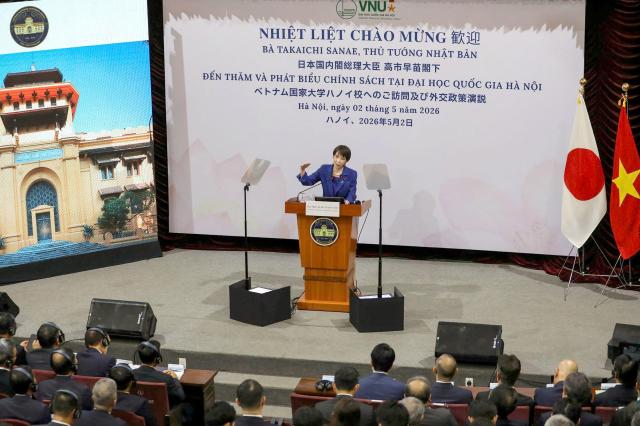
Japan’s Prime Minister Sanae Takaichi, visiting Vietnam, used a foreign policy speech to lay out a new diplomatic line, revising the “Free and Open Indo-Pacific” (FOIP) concept first advanced in 2016 by former Prime Minister Shinzo Abe. The update shifts the emphasis decisively toward economic security, including stronger supply chains for critical goods, analysts said.
Speaking at Vietnam National University in Hanoi to an audience of 270 students and experts, Takaichi said, “The environment around us has changed greatly, but the validity of FOIP remains unshaken,” adding that Japan would “play an even more proactive role than before.” She set out three priorities: building an economic ecosystem by strengthening energy and critical-material supply chains; jointly developing new economic fields and sharing rules through public-private cooperation; and expanding linkages in the security domain.
Takaichi also said Japan would promote a “FOIP digital corridor” focused on information and communications infrastructure such as undersea cables and communications satellites. She said Japan would expand both the number of countries and the scale of its Official Security Assistance (OSA) program, which provides weapons and equipment free of charge to friendly militaries. She also pledged an early start to procedures to expand the Trans-Pacific Partnership (TPP).
Japanese media offered differing readings of the revised plan. Nikkei said the update is aimed at responding to an era of “power” shaped by the United States and China, and at preserving a wavering “rule of law” by putting economic security at the center and prioritizing practical cooperation with partners.
Nikkei highlighted what it called a key difference from 2016. When Abe first promoted FOIP, Japan and the United States held up shared values such as “freedom from coercion,” the “rule of law” and a “market economy.” A decade later, Nikkei wrote, “the United States, FOIP’s most important partner, has come to ‘coerce’ countries by using tariffs.” The newspaper also said the United States showed disregard for international law in a military clash with Iran and described the Strait of Hormuz as having been “reverse-blockaded.” In Nikkei’s framing, the United States shifted from a country that should not be a coercer to one acting as a coercer.
Nikkei also pointed to China’s export controls on critical materials and Russia’s invasion of Ukraine as factors creating an environment in which countries “cannot help but follow power.” It said Takaichi’s call for “autonomy” and “resilience” across the economy, society and security fit that context.
Yomiuri Shimbun said the revised FOIP is aimed at China, which it said is intensifying coercive moves on both the economic and military fronts. It reported that Takaichi warned low-cost Chinese artificial intelligence could be used for influence operations and stressed joint development of local-language AI with Southeast Asian countries. Yomiuri also said she signaled a response to market distortions, citing “unfairly low-priced supply,” in remarks it linked to China amid concerns about overproduction in sectors such as electric vehicles and steel.
Yomiuri also cast a $10 billion financial support package announced by the Japanese government last month, dubbed “Power Asia,” as a core tool of Takaichi’s diplomacy. It said the package could be used urgently, including to support crude oil procurement for Southeast Asian countries during the Strait of Hormuz blockade situation. A senior Japanese government official described Power Asia as “live ammunition” to put FOIP into practice. Another Foreign Ministry official said Japan’s strength is providing tailored support for what partner countries need, since Japan cannot outspend China in scale.
At the same time, Japanese newspapers voiced doubts about the plan’s effectiveness, pointing to the absence of the United States as a shared weakness. Yomiuri said the United States, pressed by Middle East developments, has little room to focus on the Indo-Pacific and warned that without U.S. cooperation the prime minister’s plan could become “a pie in the sky.” Asahi Shimbun said the second Trump administration has continued actions that deny freedom and the rule of law, including launching attacks on Iran while disregarding international law. Combined with Nikkei’s view that the United States has become a coercive actor, the three papers described different facets of the same vulnerability: physical absence, ideological departure and coercive behavior.
A second weakness, Asahi said, is that even Vietnam — the venue for the announcement — may keep its distance. Citing Futaba Ishizuka, a researcher at the Institute of Developing Economies, Asahi reported that while Vietnam joined the Indo-Pacific Economic Framework (IPEF), it has avoided using the U.S.-promoted phrase “Indo-Pacific” in major domestic policy documents. The move was seen as reflecting sensitivity to China, a neighboring socialist country and Vietnam’s largest trading partner, and Asahi said Vietnam is expected to “carefully balance” its stance on the revised FOIP as well.
A third weakness is the diverging positions among Southeast Asian countries. Yomiuri said there are differences in temperature on security cooperation: the Philippines is considering importing used Japanese weapons and equipment, while Cambodia and Indonesia have held successive “2+2” meetings of foreign and defense ministers with China since last year. The paper said the reality is not a unified ASEAN line but a region split in multiple directions.
Takaichi’s revised FOIP has opened with a high-profile rollout, but Japanese media said Japan faces a heavy task in rallying partners without the United States. Vietnam’s cautious approach and Southeast Asia’s fragmentation have emerged as early variables. How Japan manages partner diplomacy amid U.S. absence remains a key test, with implications for South Korea’s Indo-Pacific strategy and its ASEAN diplomacy.
* This article has been translated by AI.
Copyright ⓒ Aju Press All rights reserved.