

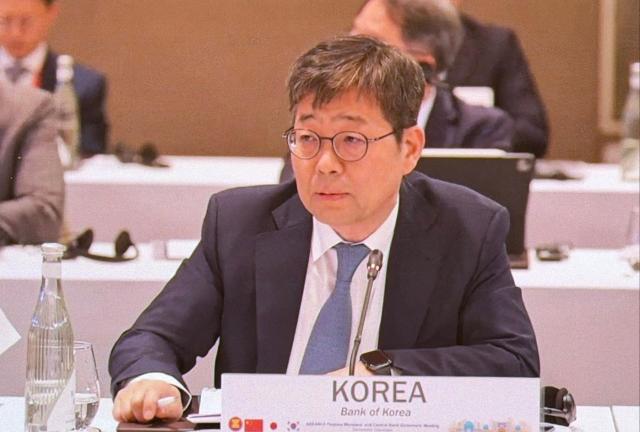
Bank of Korea Deputy Gov. Yoo Sang-dae met with Asian counterparts to strengthen the region’s financial safety net and build a next-generation framework for financial cooperation, including a plan to overhaul the safety net’s funding structure and broaden cooperation to stock and derivatives markets.
Yoo attended the 29th ASEAN+3 finance ministers and central bank governors meeting on May 3 (local time) in Samarkand, Uzbekistan, where participants discussed those steps. Timor-Leste, which joined ASEAN as its 11th member in October last year, attended the meeting for the first time, expanding the scope of regional financial cooperation.
Members shared the view that downside risks to the regional economy have increased amid rising tensions in the Middle East. They said a prolonged conflict could spread beyond energy to industrial raw materials, logistics and food prices, with broad and lasting effects. They agreed to continue policy responses tailored to each country’s conditions to support macroeconomic and financial stability.
South Korea has also faced persistent upward pressure on prices since the outbreak of war. The consumer price index rose 2.2% in March from a year earlier, driven by a sharp jump in petroleum product prices. Producer prices rose 1.6% in March from the previous month, the biggest monthly increase in more than four years since April 2022.
The meeting approved a detailed roadmap to improve the effectiveness of the Chiang Mai Initiative Multilateralization, or CMIM, the region’s financial safety net. Members agreed to push for the swift entry into force of a Rapid Financing Facility, or RFF, to respond to external shocks such as natural disasters. They also agreed to shift CMIM resources to a paid-in capital, or PIC, model to increase certainty of funding support.
The Bank of Korea is co-chairing a technical working group studying the funding-structure shift and is leading the institutional design. It plans to review specific PIC models. The working group, launched in late 2024 under the leadership of the Bank of Korea and Malaysia’s central bank, has studied models to reshape CMIM into a structure similar to the International Monetary Fund.
“With the Middle East situation increasing the importance of the regional safety net, the shift to PIC will strengthen the safety net’s credibility, availability and responsiveness,” Yoo said. “As co-chair of the TWG, I will responsibly push ahead with PIC governance issues and model design.”
Members also agreed to significantly broaden the scope of financial cooperation. They decided to expand and reorganize the existing Asian Bond Markets Initiative, or ABMI, into the Asian Bond and Financial Markets Development Initiative, or ABFMI, to cover stock and derivatives markets as well.
The 30th ASEAN+3 finance ministers and central bank governors meeting will be held next year in Nagoya, Japan. South Korea and Singapore are set to serve as co-chairs.
* This article has been translated by AI.
Copyright ⓒ Aju Press All rights reserved.