

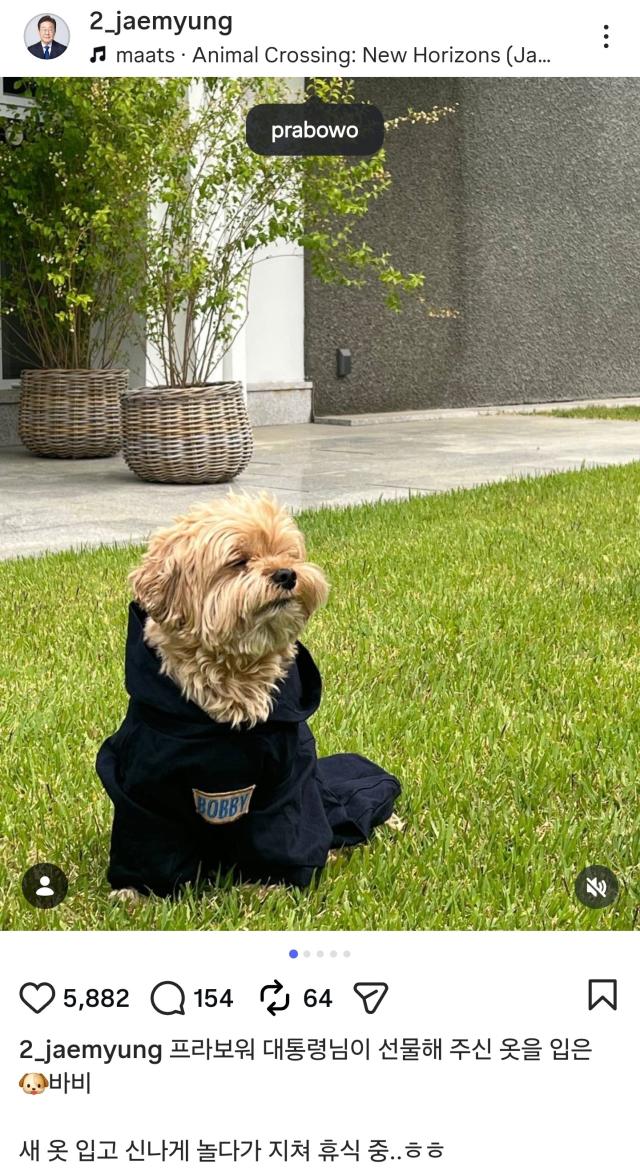
When a dog shows up in political news, the mood changes. Summit outcomes and joint statements can feel remote, but a photo of a pet running across a lawn is instantly understood. That was the effect of the recent images President Lee Jae-myung shared of his dog, Bobby. The dog was shown running in clothes gifted by Indonesian President Prabowo Subianto — a scene that carried its own message, conveying emotion without words.
Many people smiled and drew a simple conclusion: The leaders must be on good terms. That quick reaction captures the power of pet diplomacy. Even without knowing diplomatic jargon, the public can sense the temperature of a relationship.
Pet diplomacy is not new. A widely known example is the Pungsan dogs Kim Jong Un gave to President Moon Jae-in. The two dogs were more than pets. Appearing amid tension in inter-Korean relations, they became a symbolic sign of “peace” and “trust.” People reacted first to the dogs themselves, and that emotion helped soften perceptions of the relationship.
Similar scenes have played out abroad. President Vladimir Putin received an Akita dog from Japan and publicized it as a symbol of bilateral ties. In the United States, President Joe Biden’s dogs, Major and Champ, became familiar images of daily life at the White House. The article draws a distinction: Pets exchanged as gifts between leaders, such as Pungsan dogs or an Akita, function as diplomatic symbols, while a leader’s personal pets are closer to an extension of domestic political image-making. The former signals state-to-state relations; the latter highlights a politician’s approachability.
Why pets? The reason is straightforward: They draw out basic human emotion. In South Korea, about 10 million people live with companion animals. Dogs are widely seen as family. Their presence lowers defenses and opens people up. Political messages can be doubted, but a dog’s expression is not. That makes pets a powerful soft tool in diplomacy.
Still, the article argues, pet diplomacy does not change the essence of diplomacy. Relations between countries continue to be driven by interests and strategy. A single dog photo will not resolve trade disputes or reduce military tensions.
Its value lies elsewhere: It can change the process, even if it cannot change the outcome. One of diplomacy’s hardest tasks is setting a tone that allows talks to begin. When the other side is seen as an enemy, dialogue stalls. Pets can ease that point of friction by creating a human connection, lowering tension and helping form the minimum trust needed to keep conversations going. In that sense, pets do not directly increase negotiating power, but they can help create conditions in which negotiation becomes possible.
The article also warns that pet diplomacy overlaps with image politics. Warm scenes with cute dogs highlight the positive side of a relationship. The risk comes when imagery replaces substance. If images are used to obscure reality, diplomacy can be distorted. The standard, it says, should be clear: Emotion is a supporting tool and must not substitute for policy.
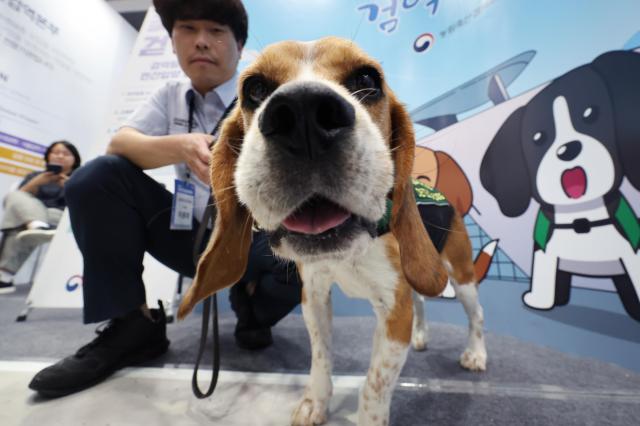
Another practical issue is responsibility. Pets are living beings, not objects, and require care. The Pungsan dog case also drew controversy over breeding and management. The article notes that a creature introduced as a diplomatic symbol can, over time, become an administrative burden.
Even so, the article says pet diplomacy is unlikely to disappear and may expand, because people respond more strongly to warm stories than to rigid diplomacy. For the approach to last, it argues, several conditions are needed: clear follow-up care systems, a firm distinction between diplomatic symbolism and personal image use, and balance so emotional staging does not replace policy. With those in place, pet diplomacy can become more than a one-off event and take hold as a strategy.
Diplomacy, the article concludes, is changing. Where power and logic once dominated, emotion and imagery now operate alongside them. Everyday moments on social media have become as important as handshakes in meeting rooms, and the public often reacts more strongly to human moments than to official announcements.
In that shift, dogs have become unexpected messengers, delivering signals faster and more widely than politicians’ words. A president’s pet, the article says, can serve as a key that opens diplomatic doors or a sign of how warm — or cold — a relationship is.
And through that small presence, it adds, people increasingly read the biggest story of all: relations between nations.
* This article has been translated by AI.
Copyright ⓒ Aju Press All rights reserved.