

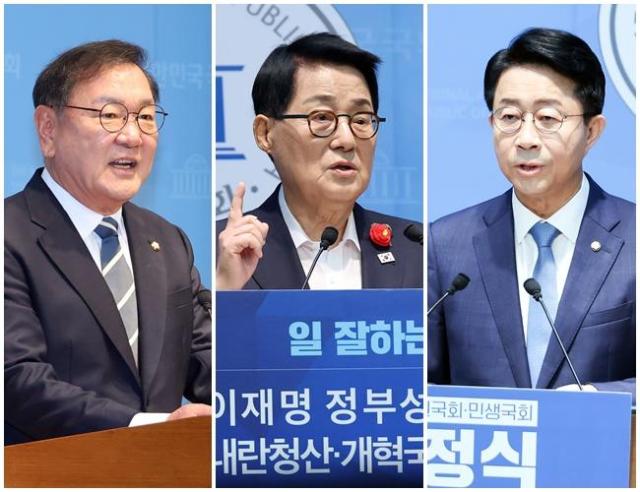
The race to choose the National Assembly speaker for the second half of the year began in earnest on May 4 as the Democratic Party opened candidate registration. Five-term lawmakers Kim Tae-nyeon and Park Jie-won and six-term lawmaker Cho Jung-sik each declared their candidacies, setting up a three-way contest.
With the Democratic Party holding a majority of seats, its internal primary is widely seen as the decisive contest. Kim pitched an “effective, working Assembly,” Park called for “ending insurrection forces and completing reforms,” and Cho emphasized a “livelihood-focused Assembly.”
Kim told a news conference at the Assembly that he proposed the 2020 “Working National Assembly Act” and the 2026 “Effective Working National Assembly Act.” “To complete the era of popular sovereignty through institutions and protect Korea’s future amid a wave of major transformation, we need an Assembly that works well. I, Kim Tae-nyeon, am the right person,” he said.
He said the framework is ready to be implemented, arguing that plenary sessions would open automatically, bills would be handled within deadlines, and committee chairs who do not work could be replaced.
Kim also pledged to complete legislation for the “popular sovereignty government’s” policy agenda, make constitutional revision a reality, create a strategic council for the people’s economy, elevate parliamentary diplomacy to a national strategy, and turn the Assembly into a venue for social dialogue.
Park, the party’s oldest lawmaker, said “insurrection forces” were still blocking the president’s governance and reforms toward what he called a “real Republic of Korea.” He accused the main opposition party of rejecting even minimal constitutional changes, including adding the March 15 uprising, the Bu-Ma Democratic Protests and the May 18 Gwangju Uprising to the Constitution’s preamble and tightening requirements for martial law, while “handpicking and nominating insurrection forces.”
“We must make the Lee Jae-myung government a success and open wide the door to the Seventh Republic and recreate the administration — only then can we finally end the insurrection,” Park said. “This is the last wish I want to fulfill as Park Jie-won, who has been able to live again thanks to the people and party members. Give a chance to Park Jie-won, who will support you better,” he added.
Park’s pledges included proactive steps on prosecution and judicial reform to “complete the revolution of light,” building a “K-Assembly that works,” strengthening lawmaker diplomacy and special envoys, and creating a tentative “National Assembly Future Special Committee” to prepare for AI, future energy, robots, the population and regional extinction crisis, and low birthrates and aging.
Cho, the party’s most senior lawmaker by terms and who stepped down the previous day as the president’s special adviser for political affairs, said the Lee Jae-myung government was showing the public “the effectiveness of politics” through fast results. “Now it’s time to show the public the effectiveness of the National Assembly as well,” he said.
“What matters most for a speaker from the ruling party is coordination with the government and stability. As a proven six-term lawmaker, I, Cho Jung-sik, am the right person,” he said, calling the bid his third run for speaker and his final political challenge in Yeouido.
Cho’s key pledges included building a “livelihood-focused Assembly” and a “popular sovereignty Assembly,” completing constitutional revision, strengthening the Assembly’s role and standing, and expanding parliamentary diplomacy.
Two four-term lawmakers, Nam In-soon and Min Hong-cheol, also entered the race for the deputy speaker post allocated to the Democratic Party. Nam urged support for “a female deputy speaker who communicates and listens,” saying she would raise the Assembly’s sensitivity to human rights. Min said he believed a deputy speaker from Yeongnam — often described as difficult terrain for the party — could become “the signal flare for victory.”
The Democratic Party plans to pick its nominees for speaker and deputy speaker on May 13 and later put them to a plenary vote. The party will combine an online vote of dues-paying members (20%) held over two days starting May 11 with an in-person vote by lawmakers on the day of selection (80%).
Election in the plenary session requires approval by a majority of all lawmakers. With the Democratic Party holding a majority, passage is expected to be smooth.
The Assembly speaker ranks second in the state protocol order and has authority to open plenary sessions and bring bills to the floor. The new speaker’s approach is expected to shape the legislative calendar and handling of contentious bills in the second half of the year.
* This article has been translated by AI.
Copyright ⓒ Aju Press All rights reserved.