

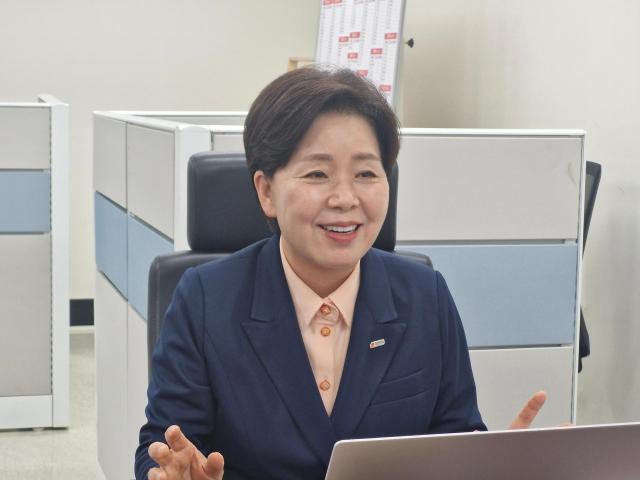
People Power Party candidate Yang Hyang-ja, laying out her vision for Gyeonggi Province, put semiconductors ahead of politics. “In the end, it’s about who can do it,” she said, arguing that industrial competitiveness drives regional and national strength.
In the Gyeonggi governor’s race, Yang has described herself less as a “politician” than as an “industry expert.” She also framed her matchup with Democratic Party candidate Choo Mi-ae not as a contest between female politicians, but as “a showdown between an advanced-industry expert and a legal professional.”
Yang, a former semiconductor engineer who joined Samsung Electronics as a research assistant and rose to executive director, served as a 21st National Assembly lawmaker. She is currently a People Power Party supreme council member and chair of the party’s special committee on advanced industries, including semiconductors and artificial intelligence.
In an interview with Ajou Economy, Yang pledged to raise Gyeonggi’s per-capita gross regional domestic product, now about 46 million won, to 100 million won. She said about 80% of the province’s GRDP is generated in the south and vowed to promote industries tailored to the characteristics of each of its 31 cities and counties to achieve more balanced north-south development.
Yang called Gyeonggi the heart of South Korea’s advanced industries.
“Even amid U.S.-China rivalry, Taiwan prospers because a global semiconductor company called TSMC shapes the world’s industrial order,” she said. “Gyeonggi’s memory semiconductors serve as the heart that can make South Korea a leading power.”
Yang said her mission is to build “a science-and-technology powerhouse” and “a prosperous, strong nation that leads the world,” adding that such a goal “can ultimately be achieved through semiconductors.” She said the province needs a governor with expertise and a vision for advanced industries and that the election would prove that point.
She repeatedly stressed that Gyeonggi is the core base of the country’s semiconductor industry. “Eighty-four-point-six percent of the value added and 76% of sales in our semiconductor industry come from Gyeonggi,” she said, arguing that an advanced-industry expert should lead the province.
Targeting her rival, Yang said Choo, “a legal technician,” knows “nothing at all” about advanced industries. “Gyeonggi needs an industry expert, not a legal technician,” she said.
On the issue of relocating the Suwon military airfield, Yang said it should be approached at the national level.
Yang said she has experience handling and resolving the Gwangju military airfield issue first. Because military airfields are national infrastructure managed by the Defense Ministry, she said, the central government should take responsibility for relocation decisions.
She said a governor’s role is to mediate and resolve conflicts among cities and counties, adding that she is best suited to do that. She said it would be difficult for Choo, whom she called a “conflict maker.”
Yang said that because South Korea remains in an armistice situation, officials should first consider where a military airfield should be located to protect security most efficiently. “The situation is complex, but the essence is simple,” she said. “All issues must be approached from the essence.”
Yang also emphasized the role of local government as a check on what she called the ruling party and government’s “runaway” power.
“Candidate Choo will move relying only on the president’s power, and that is extremely dangerous,” Yang said. She added that her work as head of the National Human Resources Development Institute gave her a deep understanding of the civil service and government systems. “Trust and choose Yang Hyang-ja, who understands industry and administration,” she said, adding, “Collective intelligence is alive in Gyeonggi. I will move forward trusting only the collective intelligence of the residents.”
* This article has been translated by AI.
Copyright ⓒ Aju Press All rights reserved.