

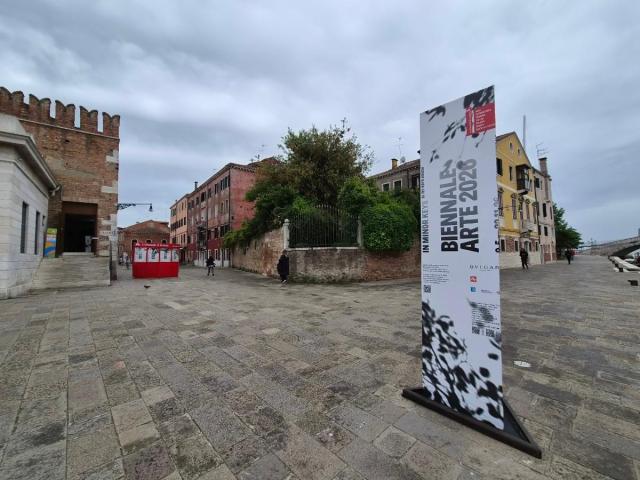
‘Art world Olympics’ set to open
The Venice Biennale, often called the “Olympics of the art world,” will run from May 9 through Nov. 22, with preview days May 6-8. The world’s oldest art biennale is held every two years.Events span the Giardini and Arsenale, as well as venues across Venice and nearby islands. The international exhibition curated by the late Koyo Kouoh will feature 111 artists and teams. Yo-E Ryou is the only invited Korean artist; Korean diaspora artists including Michael Joo and Gala Porras-Kim are also on the list.
The Biennale consists of the international exhibition, titled “In Minor Keys,” and national pavilion shows. More than 100 national pavilions will operate, including 30 permanent pavilions in the Giardini. Qatar, newly added to the permanent pavilions, will exhibit in a tent-like structure on its future building site because construction is not yet complete. Dozens of nonpermanent pavilions — including those of China, India, Argentina, Mexico, Saudi Arabia and Turkey — will be spread across the city. The main exhibition will be staged simultaneously at the Giardini and the Arsenale. Seven countries — Guinea, Equatorial Guinea, Nauru, Qatar, Sierra Leone, Somalia and Vietnam — are participating for the first time. El Salvador is also making its debut with its own venue.
Who was the curator?
The artistic director of the 61st Venice Biennale was Koyo Kouoh (1967-2025). Born in Cameroon and raised in Zurich, she was appointed in late 2024 as the first African-born woman to lead the Biennale. She served as executive director and chief curator of Zeitz Museum of Contemporary Art Africa (Zeitz MOCAA) from 2019. She died suddenly in May 2025 at age 57, shortly before the opening. Organizers said it was the first time in Biennale history that an artistic director died before the exhibition opened, and decided to proceed as planned. A five-member curatorial team she assembled is carrying out her vision. 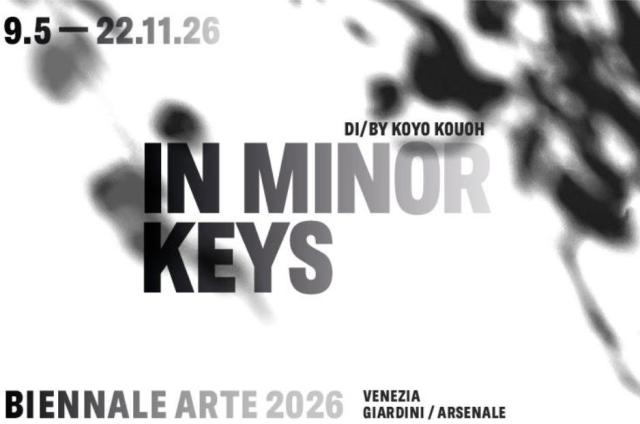
In Minor Keys
The theme, “In Minor Keys,” draws on the musical concept of the minor key. Kouoh urged audiences to “listen to the frequency of the minor key,” writing that amid “uneasy noise and confusion” sweeping the world, music continues — “songs of those who make beauty in tragedy, melodies of those who rise again from ruins, and harmonies of those trying to heal wounds and the world.” The framing signals a shift away from spectacle toward slower, deeper looking, presenting art as a space for reflection, recovery and connection. The main exhibition will avoid rigid sections, linking more than 110 participating artists through loose relationships shaped by different places and contexts, expanding what it calls a “relational geography.” It will unfold around overlapping motifs including Shrines, Procession, Schools, Rest and Performances.
Women and performance
Women artists are especially prominent. Britain’s pavilion features Lubaina Himid, a Black woman who won the Turner Prize in 2017, while France’s pavilion includes Yto Barrada. Women artists also stand out in pavilions including Austria, Estonia, Finland, Germany, Ireland, Iceland, Cyprus and Denmark. Performance is emphasized in several national presentations, including those of South Korea, Austria, Belgium and the Netherlands.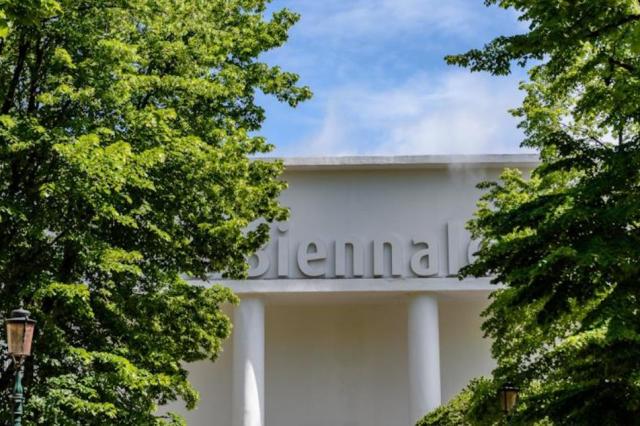
Awards likely moved to November after jury resigns
The Biennale’s prizes include the Golden Lion awards (for national pavilions, best artist and lifetime achievement), as well as the Silver Lion and special mentions. The awards ceremony is typically held at the opening. This year, however, all jurors resigned as a group, making it likely the ceremony will be held at the November closing. Reports said the selection process may also shift from a jury decision to a visitor vote. Five jurors, including Solange Oliveira Farkas, were reported to have clashed with organizers over Russia’s and Israel’s participation.The jurors had previously said that, to defend human rights, they would exclude from judging any national pavilion from a country led by a leader indicted by the International Criminal Court for crimes against humanity. Russian President Vladimir Putin is the subject of an ICC arrest warrant over alleged war crimes related to the invasion of Ukraine. For Israeli Prime Minister Benjamin Netanyahu, the ICC prosecutor has sought an arrest warrant over allegations related to Gaza; reports said that because it remained at the request stage, whether Israel would be excluded could depend on the jurors’ judgment.
War-related disputes spread across pavilions
Russia did not participate in the 2022 and 2024 Venice Biennale after its invasion of Ukraine, but will return in 2026. Russia opened a permanent pavilion in the Giardini in 1914. It is expected to open only during the preview and then close afterward amid opposition from the European Union. During the 2024 preview, Israel’s pavilion was voluntarily closed by artist Ruth Patir and curators, citing the situation in Gaza. Afterward, Israel’s government was reported to have added a contract condition in the artist selection process stating the pavilion cannot be closed. This year, with its Giardini pavilion closed for renovations, Israel will exhibit at the Arsenale. Iran notified organizers it will not attend.
South Africa’s pavilion will be empty for the first time in 15 years. The government canceled its participation in January, saying Gabrielle Goliath’s work “Elegy” could “cause division.” The piece mourns victims including Palestinian poet Hiba Abu Nada, who died in an Israeli airstrike in October 2023. The work will be shown at Chiesa di Sant’Antonin, a church built in the 7th century in Venice’s Castello district.
Australia’s pavilion drew controversy over Lebanese Australian artist Khaled Sabsabi’s 2007 work “You,” which includes footage of a Hezbollah leader’s speech. Participation by Sabsabi and curator Michael Dagostino was canceled, then later reinstated after backlash from the art community.
The United States faced fallout after the Trump administration changed Biennale support conditions, dropping equity-related standards and emphasizing “promoting American values” and the “ability to demonstrate American exceptionalism.” Some selected artists refused to participate. Alma Allen will ultimately lead the U.S. pavilion.
Korea Pavilion and Korean artists
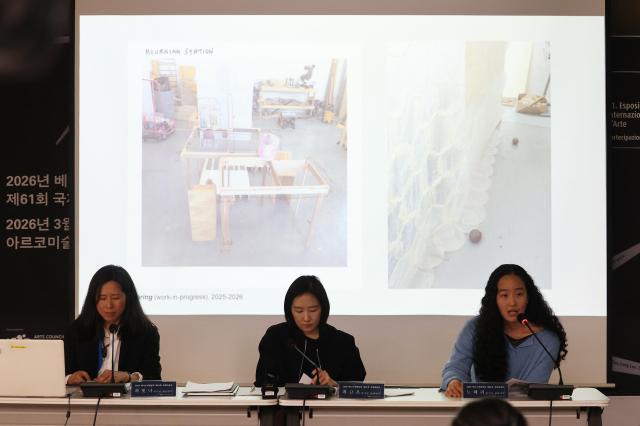
The Korea Pavilion theme is “Liberation Space: Fortress and Nest.” It revisits the “liberation space” period from 1945 to 1948 — the transition after Japanese colonial rule as a new state was sought — and extends it as an ongoing question, re-sensing and carrying it forward in aesthetic terms. Curator Choi Bitna said at a March news conference that she focused on 1995, when the Korea Pavilion was established. “That was when the Gwangju Biennale first opened and the Korea National University of Arts was founded. Demolition of the former Japanese Government-General building also began. It led into the start of a civilian government. It was a moment of transition,” she said. Artists Choi Go-eun and Cho Hyeri will present a sculptural installation and a durational practice titled “Meridian” and “Bearing,” respectively. Fellows will include creators and activists from cultural and social fields, including novelist Han Kang. The Korea Pavilion is also pursuing a collaboration with the Japan Pavilion, the first such cooperation between the two. Korean artist Yo-E Ryou was invited to the main exhibition. Gala Porras-Kim will carry out a joint project with the Victoria and Albert Museum. Artist Choi Jeong-hwa will participate as a collaborator in the Japan Pavilion, and artist Cho Kuk-hyun was invited to the Tanzania Pavilion. Artist Hong Eunju will take part in the Taiwan Pavilion opening performance. Exhibitions involving Lee Ufan, Yoon Song-yi, Shim Moon-seup and Lotus Kang are also planned.