

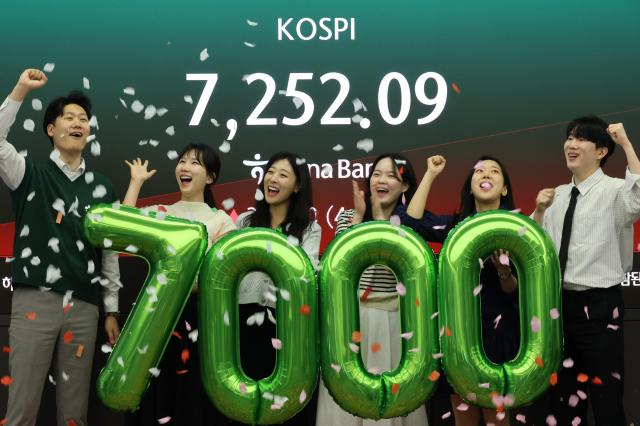
South Korea’s stock market has entered the “7,000 KOSPI” era. The benchmark KOSPI’s first-ever move above 7,000 is more than a round-number milestone, signaling a shift from the long-running “box market” that had weighed on sentiment. The advance comes despite concerns over foreign outflows, geopolitical risks and low-growth worries, suggesting investors are reassessing the market.
Semiconductors have led the rally. Surging demand for AI chips, centered on Samsung Electronics and SK hynix, has lifted the broader market. A global tech-stock run and record highs in U.S. equities have also boosted expectations for Korean chipmakers’ earnings. Some market analysts say that even at current levels, the stocks still look undervalued given the pace of profit growth expected at Samsung Electronics and SK hynix.
Still, framing the move as only a “semiconductor market” misses a key point: gains have spread to defense, shipbuilding, power, machinery and securities firms. Rather than a spike confined to one sector, the market is increasingly reflecting expectations of broader profit improvement. Market participants also point to the KOSPI’s market capitalization topping 6,000 trillion won for the first time and to a sharp rise in its global market-cap ranking.
A major change is the debate over the “Korea discount.” South Korean equities have long been marked down for geopolitical risk, limited shareholder returns and opaque governance. Recently, the government and political circles have pushed capital-market revitalization and “value-up” policies, helping shift sentiment.
The Lee Jae-myung government has also promoted capital-market advancement as a key economic task beyond the “KOSPI 5,000” goal. Many analysts say the recent surge reflects a mix of policy expectations and expanding global liquidity.
But a higher index does not automatically mean a stronger economy. If the gap between the real economy and stock prices widens too far, markets can quickly become vulnerable to sharp swings. A recent jump in international oil prices, Middle East risks and fears of a slowdown remain ongoing. Some analyses also say economic sentiment indicators are falling and that conditions felt by households and businesses have not clearly improved.
South Korean stocks have repeatedly surged and then fallen. Excessive margin trading by retail investors and short-term momentum buying have often amplified shocks. The rapid increase in market-side funds and margin loans is another warning sign. The longer the rally lasts, the more discipline investors need. Markets do not rise forever on expectations alone; sustained gains require corporate earnings and industrial competitiveness.
The government, too, should avoid complacency. It can be risky to present a market rise solely as a policy achievement, because markets can reverse quickly. The priority is not short-term index management but structural reforms that strengthen corporate competitiveness and raise trust in capital markets: improving regulatory predictability, reducing outdated practices that undermine shareholder value, and building conditions in which global investors can invest with confidence.
Crossing 7,000 is a beginning, not an end. For South Korea to move toward a truly advanced capital market, the celebration of numbers must translate into structural change. A market that relies only on an AI-and-semiconductor boom may not last. Only with stronger industrial competitiveness, capital-market reform and better corporate governance can the “Korea discount” fade into history.
* This article has been translated by AI.
Copyright ⓒ Aju Press All rights reserved.