

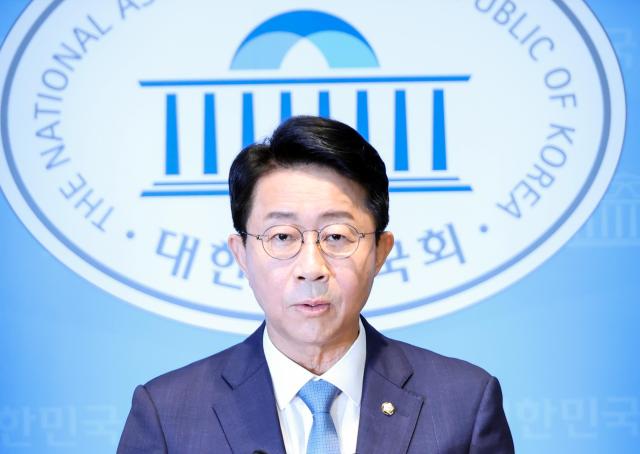
Democratic Party lawmaker Cho Jung-sik on May 4 announced his bid to become speaker in the second half of the National Assembly term. Cho has highlighted his recent work as a special adviser for political affairs in President Lee Jae-myung’s government, aiming to consolidate support among pro-Lee lawmakers and distinguish himself from rival lawmakers Kim Tae-nyeon and Park Jie-won.
Some analysts say Cho could gain an edge in the party’s internal contest, often treated as the decisive race. However, a newly proposed special counsel bill on alleged “fabricated indictments” could become a variable.
■ Strengths(강점)
Political circles say Cho’s ability to communicate smoothly with the government is a key strength. In his candidacy statement, he said, “As a National Assembly speaker from the ruling party with blue blood, I will help ensure the success of the people’s sovereignty government and lay a bridgehead for victory in the 23rd general election and the recapture of power.”
After Cho resigned as special adviser on May 3, President Lee wrote on Facebook, “You worked hard. I sincerely thank you for always being with us.” Some interpreted the message as support for Cho’s speaker bid.
Cho is now the Democratic Party’s only six-term lawmaker after Choo Mi-ae, a Gyeonggi governor candidate, resigned her seat to run. That gives Cho seniority over five-term rivals Kim and Park. Given past practice in which the most senior lawmaker often became speaker, some say Cho has a strong claim.
Born in 1963, Cho is also younger than Park, who was born in 1942, a 21-year gap. Supporters say that could matter for a physically demanding post that can include marathon sessions such as filibusters.
■ Weaknesses(약점)
Cho’s lower name recognition compared with Park is cited as a weakness. Park has ranked first in multiple opinion polls.
This election will also be the first Democratic Party speaker race in which votes by dues-paying party members count for 20%. The rule was introduced after some hard-line supporters protested when Choo, seen as having the party leader’s backing in the 22nd first-half speaker race, lost to Speaker Woo Won-shik. If the party-member vote tracks opinion polls, it could work against Cho.
■ Opportunities(기회)
Cho, known as a policy specialist in Seoul politics and a former chair of the party’s policy committee, can stress efficiency in core speaker duties such as coordinating floor schedules and putting bills on the agenda.
He also served as party secretary-general during the first leadership under Lee, when Lee led the party, and played a role in nominations for the 22nd general election. Observers say that could help him secure support from many pro-Lee first-term lawmakers.
Cho has framed the race as his third attempt — after the second half of the 21st Assembly and the first half of the 22nd — and as his final bid before ending his Yeouido political career. Some say that could build sentiment among colleagues to give him a chance this time.
Often described as a moderate, Cho has also raised expectations for bipartisan cooperation. He has said he would be “a livelihood-focused speaker who respects cooperation between the ruling and opposition parties while making firm decisions on people’s lives.”
■ Threats(위협)
The special counsel bill on alleged “fabricated indictments,” which has drawn controversy, could also affect Cho’s prospects. Shin Yul, a professor of political science and diplomacy at Myongji University, told Aju Business in a phone interview that “if the president’s approval rating falls due to the special counsel bill, it could affect Cho.” Cho has said of the controversy, “It must be properly clarified through a special counsel.”
The Democratic Party proposed the bill after wrapping up work on April 30 by a special committee for a parliamentary investigation into the allegations. Disagreements emerged within the party over a provision that would have the special counsel maintain prosecutions in cases transferred to it.
There has also been uncertainty over timing. President Lee said on May 4 he would leave the decision to the party, while party leader Jung Cheong-rae said May 5 he would consult with the presidential office. As the People Power Party attacks the measure as a “special counsel to erase the president’s crimes,” observers say it cannot be ruled out that President Lee’s approval rating could swing.
* This article has been translated by AI.
Copyright ⓒ Aju Press All rights reserved.