

Overall exports in the first quarter climbed 37.8% to $219.9 billion, the highest first-quarter total on record. The surge has fueled expectations South Korea could rank fifth globally in exports.
The Ministry of Trade, Industry and Energy said Tuesday it revised its MTI product codes used for trade analysis and released first-quarter 2026 export and import trends based on the updated system. MTI codes are the ministry’s reclassification of the globally used HS codes to better reflect Korea’s industrial structure. The revision was the first since 2020.
The ministry expanded its list of “top export items” from 15 to 20, adding five categories that have recently shown growth: electrical equipment, nonferrous metals, agricultural and fisheries products, cosmetics and household goods. Officials said the change is intended to provide more consistent statistics and make trends easier to track.
An industry ministry official said the 2020 overhaul expanded the list to 15 items by adding biohealth and secondary batteries, and the latest revision will allow more detailed monthly explanations of fast-growing categories, including consumer goods.
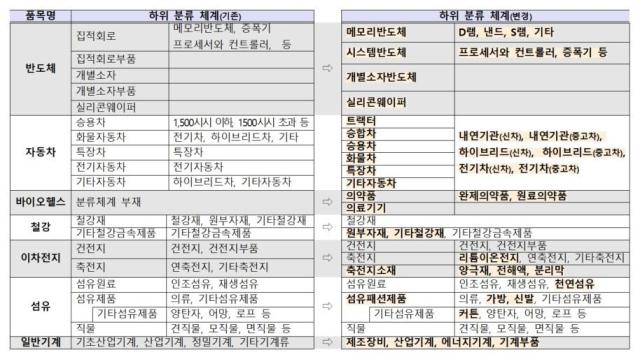
The ministry also adjusted subcategories for major exports such as semiconductors, autos and biohealth. Semiconductors had previously combined memory and system chips under a single integrated-circuit code; the revised statistics separate them, and further break memory chips into DRAM and NAND memory.
Autos were reorganized into four upper-level categories by vehicle type, such as passenger and cargo vehicles, and six lower-level categories by powertrain, and the statistics now distinguish new and used vehicles. Biohealth received a new MTI code, with subcategories split into pharmaceuticals and medical devices.
For steel, items previously included under steel materials, such as other steel products and parts and materials, were moved into a new category for other steel and metal products. For batteries, the ministry created a separate code for lithium-ion batteries, reflecting recent export growth. Natural materials and items such as bags, shoes and belts were moved into textiles. General machinery subcategories were aligned with actual industry classifications.
To maintain consistency, the government will apply the revised system retroactively to statistics from 2022 onward. The ministry said the global HS code standard changed in 2022, and the retroactive application is intended to prevent statistical mismatches within Korea’s MTI-based system.
Semiconductor exports jumped 139% to $78.5 billion. With memory prices rising, DRAM exports climbed 249.1% to $35.79 billion and NAND flash surged 377.5% to $5.39 billion. System semiconductors increased 13.5% to $12.11 billion.
Auto exports fell 0.3% to $17.2 billion. Cargo vehicle exports rose to $710 million, up 63.9%, but passenger car exports slipped 2.2% to $16.3 billion and vans dropped 31.7% to $70 million.
Biohealth exports rose 9.6% to $4.2 billion, driven largely by pharmaceuticals, which increased 11.9% to $2.73 billion.
Electrical equipment exports rose 2.5% to $4.05 billion, which the ministry attributed to sustained demand for transformers and power cables amid expanded global investment in power grids. Nonferrous metal exports rose 28.9% to $4.09 billion, reflecting higher prices for minerals such as copper and aluminum.
Textile exports slipped 0.6% to $2.52 billion. However, textile product exports rose 7.1% to $1.0 billion, which the ministry linked to stronger demand for K-fashion. Cosmetics exports increased 21.5% to $3.13 billion amid rising preference for K-beauty. Agricultural and fisheries product exports rose 7.4% to $3.11 billion, and household goods increased 3.9% to $2.1 billion.
The ministry expects the semiconductor upturn to continue for now. “Semiconductors typically show a weaker first half and stronger second half, so the first quarter is usually the off-season,” an official said. “This year, demand for AI server-related products has pushed exports above $30 billion for two consecutive months, and with DRAM contract prices high, the likelihood of continued strength is very high.”
South Korea’s global export ranking is also in focus. Under World Trade Organization data, Korea ranked fifth in exports in January and February, behind China, the United States, Germany and the Netherlands. That marked a rise from about seventh last year, surpassing Japan and Italy.
An industry ministry official said converting Japan’s March export figure, released by Japan’s Ministry of Economy, Trade and Industry in yen, into dollars suggests Japan’s exports were about $30 billion lower than South Korea’s. The official said this was the first time Korea ranked fifth in quarterly global exports.
Risks include the war in the Middle East. Officials said if a negative scenario persists — with the conflict affecting the second half of the year and pushing oil prices into next year — export trends could become difficult to predict. The possibility of a strike by Samsung Electronics’ labor union also remains.
Trade Minister Kim Jung-kwan said export conditions remain challenging due to higher oil prices tied to the Middle East war, global supply chain instability and uncertainty over U.S. tariffs. He said the government will expand trade finance and export insurance to ease companies’ funding burdens and continue measures to stabilize transport and supply chains to prepare for logistics disruptions, aiming to sustain the first-quarter export momentum.
* This article has been translated by AI.
Copyright ⓒ Aju Press All rights reserved.