

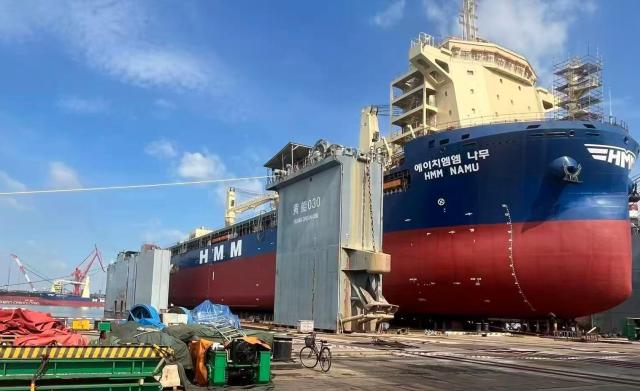
Iran has formally introduced a “prior transit permit” requirement for the Strait of Hormuz, tightening what amounts to sovereign control over a key international waterway, as the HMM-operated cargo ship Namuho — damaged by an explosion and fire in the strait — is being towed toward Dubai’s port.
About 20% of the world’s seaborne crude oil shipments pass through the strategic chokepoint. A South Korean vessel has suffered actual damage, and 26 South Korean ships and 160 South Korean crew members remain stuck inside the strait.
The Hormuz crisis is no longer a distant Middle East dispute, the column said, calling it a practical challenge now tied to South Korea’s energy security, public safety and national standing.
Iran is requiring advance permission for all transiting ships and has warned of possible military action if vessels sail outside designated routes. The move effectively seeks to restrict the right of transit passage through international straits guaranteed under the U.N. Convention on the Law of the Sea, the column said.
As the United States and Iran use the strait as leverage against each other, the area has moved beyond heightened tension into what the column described as a quasi-wartime situation. It said the United States has not presented a clear strategy.
U.S. President Donald Trump has said through “Project Freedom” that he is willing to help civilian ships leave the strait, while also alternating between talk of halting operations and pursuing negotiations. The shifting message from Washington has added confusion for allies, the column said.
It said South Korea’s caution is understandable, warning that hasty military involvement could endanger South Korean companies and citizens in the region and worsen diplomatic ties with Iran. But it argued that caution is not the same as inaction.
With the blockade continuing for more than two months, some ships have raised concerns about shortages of food and drinking water. The column urged the government, separate from any multinational framework, to use all direct diplomatic channels with Iran to secure safe passage for South Korean ships and crews, saying the most urgent priority is protecting lives and safety.
At the same time, it said South Korea should be ready to take part in international coordination. It noted that 44 countries, led by Britain and France, are discussing a defensive multinational mission to restore normal conditions in Hormuz, focused on protecting commercial vessels, clearing mines and ensuring safe navigation — not attacking Iran.
The column said South Korea’s mine countermeasures capability is emerging as a practical option. Mine-clearing operations are defensive and rescue-oriented efforts aimed at civilian shipping safety, it said, adding that the South Korean Navy has world-class expertise in mine warfare and recently demonstrated high detection accuracy and rapid clearance in a combined U.S.-South Korea mine warfare exercise.
It argued that South Korea’s mine-clearing capacity is not merely a military asset but a strategic tool that can serve as a public good by supporting international navigation order, and could also help demonstrate the competitiveness of South Korea’s defense and shipbuilding industries.
Any contribution should be limited and guided by clear principles, the column said, arguing that South Korea should not be automatically folded into a U.S. pressure strategy against Iran but should act under the goals of protecting its citizens and ensuring maritime safety — an approach it said could be accepted internationally while preserving diplomatic space with Iran.
The clashes unfolding in Hormuz are not simply a Middle East conflict, the column said, describing a geopolitical test where U.S. power, Iran’s survival strategy, international maritime order and resource security collide — with South Korea in the middle. It called for diplomatic precision and decisive execution, urging a balance of negotiating with Iran, coordinating with the international community and, if necessary, accepting limited security contributions to protect lives.
* This article has been translated by AI.
Copyright ⓒ Aju Press All rights reserved.