

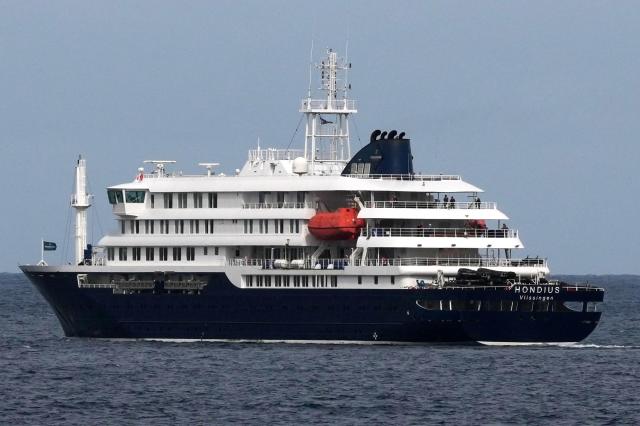
AP and Reuters reported that the Dutch-flagged MV Hondius, which had been anchored for several days off the coast of Cabo Verde, began moving on May 6 (local time) with 146 passengers and crew aboard.
The three suspected patients were taken off the ship and were being flown by air ambulance to the Netherlands. The Dutch Foreign Ministry said they are a 41-year-old Dutch national, a 56-year-old British national and a 65-year-old German national, and will be transferred directly to specialized hospitals in their respective European countries.
Authorities have identified eight suspected cases so far, including three confirmed infections. Three people — a Dutch couple and a German — have died.
One of the confirmed cases was the Dutch woman who died. Another was a British patient being treated in South Africa. South Africa’s Health Ministry said testing confirmed the Andes strain, which can spread from person to person.
Swiss authorities said one of their citizens who left the ship and returned home in late April is being treated in Zurich and was also confirmed to have the Andes strain. A World Health Organization official said the same strain was identified in samples taken in Cabo Verde, South Africa and Switzerland.
The ship departed Argentina on April 1 and traveled through remote areas including the Antarctic mainland, South Georgia Island and Nightingale Island. After infections were confirmed, Cabo Verde refused the ship entry, citing a public health threat. Spain decided to allow it to dock in the Canary Islands on humanitarian grounds.
Cabo Verde authorities said an air ambulance arrived the previous night, but stressed that once the evacuation was completed, “the ship must resume its voyage.”
Spanish Health Minister Monica Garcia told a news conference in Madrid that all remaining passengers and crew had no hantavirus symptoms and that the ship is expected to arrive in Tenerife in three days.
Garcia said that if all non-Spanish passengers are healthy, they will be sent back to their home countries, while 14 Spanish passengers will be quarantined at a military hospital in Madrid.
The Canary Islands’ regional government has objected to the central government’s decision. Regional leader Fernando Clavijo told Spanish broadcaster Onda Cero, “We cannot allow it to dock in the Canary Islands. This decision is not based on our criteria, and we have not received enough information.”
WHO: “Not like COVID-19”
The WHO said it is working with national authorities to trace the movements of 69 people who had close contact with passengers. The agency has repeatedly stressed that the situation is very different from the COVID-19 pandemic.
WHO Director-General Tedros Adhanom Ghebreyesus wrote on social media platform X that “at this stage, the overall public health risk remains low.” He said the WHO is working with the operator to closely monitor the health of passengers and crew and is coordinating with national authorities to begin medical monitoring and follow-up for passengers, including those who have already disembarked.
In an interview with AFP, Tedros said the risk in other parts of the world is low. Asked whether the outbreak resembled the early days of the COVID-19 pandemic, he said he did not think so.
Maria Van Kerkhove, the WHO’s epidemic management director, told Reuters that “close contact” for person-to-person transmission means very close physical contact, such as sharing a cabin or providing medical care. “That is very different from COVID-19 and influenza,” she said.
* This article has been translated by AI.
Copyright ⓒ Aju Press All rights reserved.