

Yu said higher energy prices and unstable supply chains could drive inflation while slowing growth. He argued South Korea’s heavy reliance on external demand leaves it among the first to feel global shocks, despite its top-10 economy and competitiveness in manufacturing, semiconductors and cultural industries.
As a response, Yu called for “market diversification,” urging South Korea to reduce dependence on exports centered on the United States and China and expand into India, Africa, Latin America and other regions. He also said Korean companies’ strength lies in their ability to adapt quickly and adopt new technologies such as artificial intelligence, adding that outcomes will depend on strategy. “Korea is still a competitive country, and if it sets the direction correctly, it can create opportunities,” he said.
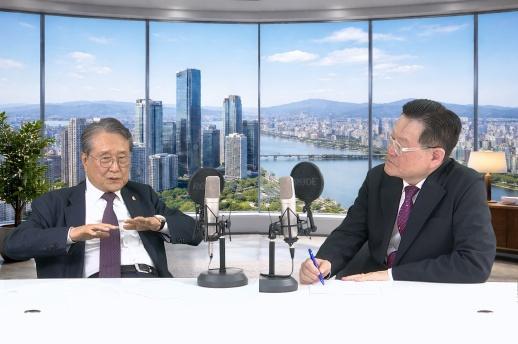
- How do you view the global economy now.
“Today’s global economy is hard to describe as a simple slowdown or recession. It is closer to a structural transition in which the international order itself is being shaken.
In the past, economic and security issues were partly separated. That is no longer the case. The Russia-Ukraine war, Middle East conflict and U.S. tariff policy are binding the economy and security into a single structure. At the same time, technological innovation such as AI is changing the business environment fundamentally.
In this situation, conventional countercyclical policy is not enough. Geopolitical risk and competition for technological dominance are working at the same time.
This is not a ‘business cycle’ crisis but a ‘change in order.’ And it will not end quickly; it could last more than 10 years.”
- What is the root cause of the free-trade order weakening.
“The free-trade system provided a stable growth environment for about 20 years after the WTO launched in 1995. But the decisive turning point was U.S.-China conflict.
China expanded its global market share on price competitiveness while using state-led industrial policy to foster specific industries. That undermined market fairness, and the United States came to see it as a threat. Tariff policy took hold under the Trump administration, and the conflict became structural.
This is not a simple trade dispute. It is a ‘hegemony competition’ linking technology, security and industrial policy, so it is difficult to resolve and likely to be prolonged.”
- How will the recent Middle East situation affect the economy.
“The Middle East has always had a major impact on the global economy because of energy. When conflict breaks out, oil supply becomes unstable and prices rise. Higher energy prices raise production costs and increase inflation pressure.
The biggest concern is stagflation — rising prices with slowing growth. Policy responses are difficult: raising rates deepens a downturn, while cutting rates can push prices higher.
Another key point is that the conflict is unlikely to end quickly. Ending a war is harder than starting one, and if energy infrastructure is damaged, restoration can take years. So this is not just a short-term shock; it could affect the global economy over the medium to long term.”
- How do you assess South Korea’s current position.
“Objectively, South Korea has reached a very high level. It has a top-10 economy and global competitiveness in semiconductors, manufacturing, bio and cultural content.
But it also has clear structural vulnerabilities. The biggest is high external dependence — a large export share and heavy reliance on specific countries. In that structure, external shocks show up quickly. If global demand falls, exports drop and growth is affected immediately.
In short, Korea has strengths and weaknesses at the same time: it is competitive, but highly exposed to the external environment.”
- What is the solution to overcome these limits.
“The most important thing is market diversification. Korea has relied heavily on two pillars, the United States and China. They remain important, but dependence on them alone is risky.
Korea should actively expand into India, Africa, Latin America and Southeast Asia. These regions have growing populations and strong potential for economic growth, making them important long-term markets.
Diversification is not just about increasing exports. It is about stabilizing the national economy by changing a structure in which the whole economy can be shaken by conditions in a single country.”
- How do you assess the competitiveness of Korean companies.
“Korean companies’ biggest strength is adaptability. They respond quickly when conditions change and actively adopt new technologies. That matters in global competition.
That strength is likely to continue in the AI era. Korea has strong digital infrastructure and IT capabilities, giving it an advantage in applying AI to industry. There may be gaps in foundational technology, but in practical use and application, Korea can be competitive. That is why Korean companies can find opportunities even in a crisis.”
- How important is South Korea-U.S. economic cooperation.
“Cooperation remains very important. The United States has top competitiveness across advanced technology, finance and manufacturing, and it basically maintains a free-market system, which provides a stable basis for cooperation.
There may be short-term friction over tariffs or industrial policy, but over the long term the relationship is likely to hold. In technology, cooperation is essential. In semiconductors, AI and bio, cooperation with the United States is a major help to Korea’s economy.”
- What is your outlook for shipbuilding and defense industries.
“Shipbuilding is facing a very interesting opportunity. U.S. shipbuilding competitiveness has weakened significantly. If Korean companies enter, they can secure market leadership.
Defense is similar. As the global security environment becomes more unstable, demand is rising. Korea has technology and production capacity, so it can be competitive. These two industries are likely to become important growth pillars for Korea’s economy.”
- What is the future of the semiconductor industry.
“Semiconductors are a core industry for Korea. There are risks, but it is also the biggest opportunity. Korea is very strong in advanced semiconductors.
The key is to sustain innovation. Korea must move beyond production-centered growth and secure high value-added technology. With intensifying global competition, continued investment and R&D are needed.”
- Where does Korea stand in the AI era.
“AI is a technology that will change every industry. Korea may lag in foundational technology, but it can be competitive in applications. AI use is spreading quickly, especially in manufacturing and content industries.
Speed is critical. Because change is so fast, a slow response can widen gaps. The government and companies should invest aggressively together.”
- What is the biggest long-term risk.
“Population cliff, talent cliff and labor cliff. The talent issue is the most serious. In the AI era, talent is competitiveness.
Korea lacks talent and also faces outflows abroad. If it cannot solve this, long-term growth will be difficult.”
- Even so, are you optimistic about Korea’s economy.
“Yes. Korea has proven competitiveness in many areas — manufacturing, technology, culture and defense, among others. Another important factor is trust: global trust in Korean products and companies is high. With those strengths, if Korea sets the direction well, it can grow.”
:Yu Jang-hee, Wonjiwon chief: Yu is a leading South Korean expert in international economics and trade. He graduated from Seoul National University’s economics department and earned a doctorate in economics in the United States, then worked across academia and policy. He led multiple economic and trade-related institutions, including the Korea Institute for International Economic Policy (KIEP), and was deeply involved in shaping South Korea’s external economic policy.
He has played an important role in South Korea-U.S. economic cooperation, working with major U.S. think tanks and corporate networks to help broaden the foundation for Korean companies’ global expansion. He has continued research on changes in the international economic order and trade policy, and has spoken consistently on issues including U.S.-China tensions, expanding protectionism and global supply-chain restructuring.
Yu is seen as combining academic analysis with a policymaker’s practical perspective, offering solutions that can be applied to economic policy and corporate strategy. He continues to study global economic trends and South Korea’s response strategies, advising both companies and government. He has emphasized “market diversification” and “corporate competitiveness” as key themes for South Korea’s economic survival amid rapid change in the global order.
* This article has been translated by AI.
Copyright ⓒ Aju Press All rights reserved.