

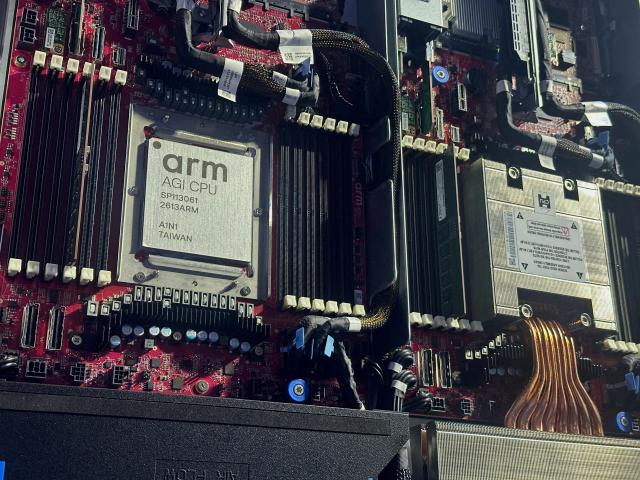
The Financial Times and The Wall Street Journal reported that Arm said in an earnings release on 7일(현지시간) that combined demand for its self-developed data center chip, the “AGI CPU,” is projected at $2 billion for fiscal 2027 and 2028. That is double the $1 billion demand forecast Arm gave when it introduced the chip in March.
Arm kept its revenue outlook for the chip at $1 billion, saying it has not yet secured enough supply to meet the full $2 billion in projected demand.
On a conference call, Arm CEO Rene Haas said the $1 billion figure cited in March reflected “secured supply” that could support that level of demand. He said that includes access to memory, wafers, packaging and test equipment, and that the company is now working to line up supply to support $2 billion in demand.
Haas added that the company is working around the clock “to find the right solutions for customers.” Arm expects revenue from the chip to begin showing up in the fourth quarter of its current fiscal year.
Arm has long grown by licensing semiconductor design intellectual property to companies including Nvidia, Google and Amazon. By launching its first finished, in-house chip in its roughly 35-year history, Arm is also positioning itself as a competitor to some of its existing customers.
The FT said that early in the AI boom, demand for CPUs was relatively limited as customers rushed to buy Nvidia GPUs to train AI models. More recently, it said, demand has risen for CPUs that support running AI applications, benefiting Arm as well as Intel and AMD.
Haas said demand for the AGI CPU “exceeded expectations” and that Arm has established itself as a computing platform for the AI era. He also forecast that CPU demand will quadruple in the future.
Arm said it expects supplying technology for AI data centers to become its biggest business over the long term. It maintained its target of reaching $15 billion in chip revenue by 2031. “The direction is clear,” Haas said, adding that customers want Arm “at the center of the data center.”
The push also aligns with a strategy by Arm’s largest shareholder, SoftBank Chairman Masayoshi Son, to build an AI semiconductor supply chain. Son has promoted what he calls the “Izanagi Project” to foster an AI chip ecosystem that can take on Nvidia. Haas was appointed last month as CEO of SoftBank International Group, taking a central role in that strategy.
Record revenue, but rising costs in focus
Arm reported first-quarter revenue of $1.49 billion, up 20% from a year earlier and a record high. Adjusted earnings were 60 cents a share, above the market estimate of 58 cents.
Royalty revenue rose 11% to $671 million on growth in smartphones and AI applications, though it fell short of some market expectations. License and other revenue climbed 29% to $819 million, beating expectations; the company attributed the increase to stronger demand for AI chip design and platforms.
For the second quarter, Arm forecast revenue of $1.21 billion to $1.31 billion and adjusted earnings of 36 cents to 44 cents a share. The market expects revenue of $1.25 billion and adjusted earnings of 37 cents a share.
Arm executives said costs tied to building out supply chains are likely to be a near-term burden. They said operating expenses are expected to rise sequentially by a few percentage points each quarter this year, but projected that by year’s end revenue growth will outpace expense growth.
Arm shares have more than doubled so far this year on expectations for its new AI chip. After the earnings release, the stock fell in after-hours trading as concerns about supply constraints and rising costs drew attention.
* This article has been translated by AI.
Copyright ⓒ Aju Press All rights reserved.