

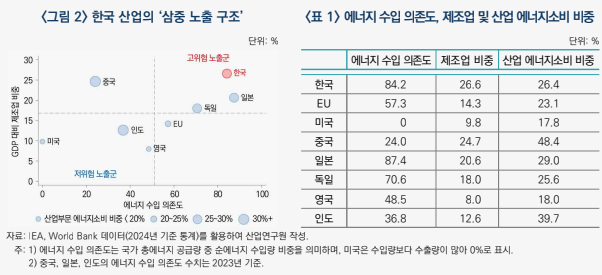
The Korea Institute for Industrial Economics and Trade said in a report released on the 7th, titled “In the era of energy security: Responding to green-transition risks for South Korean industry under a triple-exposure structure,” that the country faces a “triple exposure” of high dependence on imported energy, an economy centered on manufacturing, and heavy industrial energy use.
Analyzing 2024 data from the International Energy Agency and the World Bank, the institute said South Korea’s energy import dependence stood at 84.2%, high among major economies. Manufacturing accounted for 26.6% of gross domestic product, while the industrial sector’s share of energy consumption was 26.4%, underscoring an energy-intensive industrial base.
Under those conditions, the institute said, rising international energy prices are likely to feed directly into manufacturing costs and could squeeze spending on facilities and technology upgrades needed for the transition.
Energy-intensive industries such as steel and petrochemicals saw profitability deteriorate during the 2022 surge in global energy prices, it said. The institute added that energy security has become a structural factor affecting industrial competitiveness and the pace of the green transition, not merely a cost issue.
Major economies are already adjusting policies with energy-security risks in mind. The United States and Japan are strengthening measures that link energy security with industrial competitiveness, the report said. The United States is focusing on supply-chain restructuring and energy infrastructure investment, while Japan is pursuing its “GX (Green Transformation)” strategy alongside expanded investment in renewable energy and next-generation industries.
The European Union, it said, kept policies to expand renewable energy during the energy crisis while also using fossil fuels and promoting demand-management measures to cushion the shock.
In South Korea, calls are growing for policy steps to ease the burden on industry. The institute said near-term measures could include improving the industrial electricity pricing system to reduce cost volatility. Over the medium to long term, it said, transition finance and carbon contracts for difference, or CCfD, could help secure companies’ capacity to invest.
“Green transition is an inevitable trend, but under the current industrial structure, external energy shocks can become a burden on the transition process,” Lee Sang-won, a research fellow at the institute, said. “Rather than a speed-focused approach, we need a transition strategy with the ability to respond to shocks.”
* This article has been translated by AI.
Copyright ⓒ Aju Press All rights reserved.