

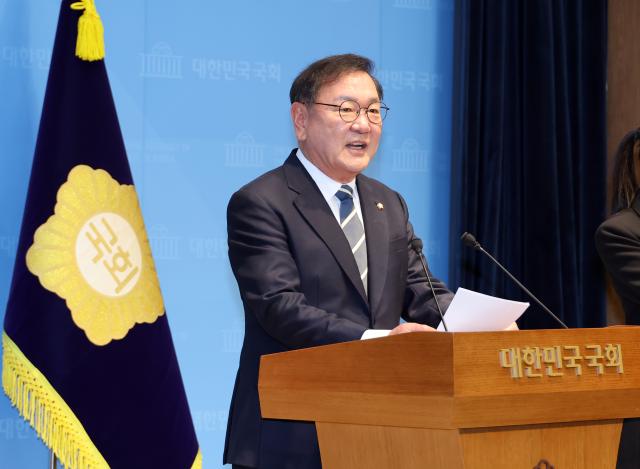
With the Democratic Party set to choose the speaker for the second half of the 22nd National Assembly, a three-way race is intensifying among Park Ji-won, Cho Jung-sik and Kim Tae-nyeon, in ballot order. Kim is seeking to stand out by stressing his experience designing policy and his ability to deliver results, though allies acknowledge his name recognition lags behind the other two contenders.
■Strengths(강점)
Kim is widely regarded within the party as a policy specialist and strategist, political circles said. First elected in 2004 in Seongnam’s Sujeong district in Gyeonggi province, he has held senior posts including party policy chief and floor leader. He also led the party’s “Economy Is the Democratic Party” study group, with about 120 lawmakers participating, for five years, shaping internal debate on economic issues. Ahead of the June 3 local elections, he has served as head of a drive for a “leap” in the people’s economy, unveiling livelihood-focused pledges under what he called the “Chakbut Project.”
At his May 4 announcement, Kim framed his policy credentials as central to his bid. “To build a ‘National Assembly that works well,’ we need a ‘speaker who works well,’” he said, adding that he was “the right person.” He pointed to initiatives he pushed as policy chief — including the 52-hour workweek, minimum wage increases and regulatory sandboxes — as achievements he helped translate into results.
■Weaknesses(약점)
Despite being seen as a heavyweight, Kim is viewed as less well-known than his rivals. The speaker will be chosen through a combined vote: 80% by lawmakers and 20% by party members, a system introduced for the first time after revisions to party rules. That structure increases the need to win both lawmakers and the party base.
Park is seen by many analysts as well-positioned with party members, backed by broad public recognition built through roles including chief of staff to former President Kim Dae-jung, director of the National Intelligence Service under the Moon Jae-in government, and service as a member of the 22nd Assembly’s Legislation and Judiciary Committee. Cho, a six-term lawmaker who served as special political adviser to President Lee Jae-myung, has been building support among first- and second-term lawmakers with what is described as backing from the president’s inner circle. Kim has been consolidating support among lawmakers in their second term or higher, but how much he can expand that bloc and win party members is expected to be decisive.
■Opportunities(기회)
With the Middle East crisis and domestic stability cited as pressing concerns, Kim’s policy experience and drive are being cast as assets. As floor leader during the COVID-19 period, he oversaw legislation and helped pass multiple reform bills. He has pledged to create a speaker-led “livelihood and economic strategy council” bringing together the ruling and opposition parties, the government and industry to debate key agendas for the country’s economic future and link legislation with the budget. “There is no ruling party or opposition when it comes to people’s livelihoods and the economy,” he said.
Kim also said he would push what he calls an “Assembly that works well” bill to speed up lawmaking. The proposal includes provisions to replace a standing committee chair who, without just cause, fails to convene meetings or delays bill reviews. “I will not tolerate intentional delays and disruption,” he said, adding he would disclose legislative performance to the public and be judged on results.
Kim, a five-term lawmaker from Seongnam, has also highlighted that he shares a regional base with President Lee. “I have shared the direction of politics with President Lee for more than 30 years and understand his philosophy deeply,” he said, arguing he can support the administration’s policy agenda.
■Threats(위협)
Some analysts caution that Kim’s emphasis on execution could be seen as overly hard-line. Within the Democratic Party, some have argued for taking all standing committee chair posts. As floor leader, Kim once secured all 18 chairmanships. He has defended that approach by saying it enabled the passage of the largest number of reform bills since democratization in 1987, even during the COVID-19 crisis. Critics, however, warn that similar tactics could become a liability in a second-half Assembly expected to face sharp partisan confrontation.
* This article has been translated by AI.
Copyright ⓒ Aju Press All rights reserved.