

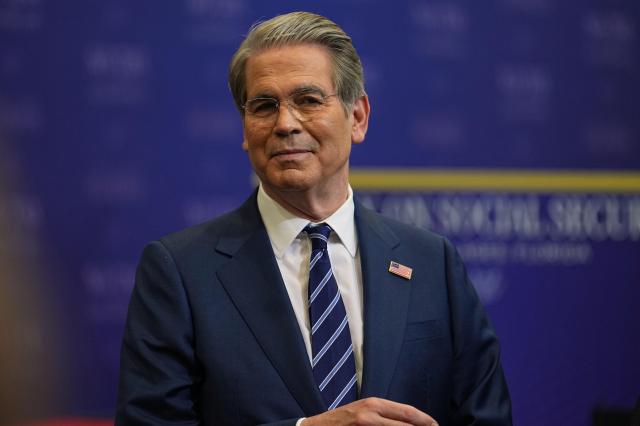
U.S. Treasury Secretary Scott Bessent plans to visit Japan ahead of a trip to China and is expected to meet separately with Prime Minister Sanae Takaichi, Finance Minister Satsuki Katayama and Bank of Japan Gov. Kazuo Ueda, Japanese media reported. The talks would come soon after Japan’s government and central bank carried out large-scale yen-buying intervention, drawing attention to whether U.S.-Japan coordination on the weak yen will deepen.
The Nikkei newspaper reported May 7, citing multiple U.S. and Japanese diplomatic sources, that Bessent will visit Japan for three days starting May 11. The stop is scheduled ahead of his attendance at a U.S.-China leaders’ summit in Beijing on May 14-15. Nikkei said plans are being coordinated for Bessent to hold separate meetings on May 12 with Takaichi, Katayama and Ueda.
The agenda is expected to include the weak yen as well as economic security issues such as rare earths and energy procurement, Nikkei reported. It said Iran could also come up, amid worsening conditions in the Middle East.
The visit is notable because it follows Japan’s foreign-exchange intervention. Japan’s government and the BOJ stepped into the market on April 30 for the first time in 1 year and 9 months, buying yen and selling dollars. The yen had weakened to the 160.70 yen range per dollar before rebounding sharply to the 155 yen range after the intervention. The U.S. Treasury told Nikkei it is “in close contact with Japan,” a comment some interpreted as a signal Washington is effectively tolerating Japan’s response in the currency market.
With the Trump administration arguing for the need for a weaker dollar, Nikkei described Bessent as sensitive to speculative yen selling, which can weaken the yen while strengthening the dollar. Nikkei also reported that a “rate check” conducted by the U.S. Treasury in January was led by Bessent rather than requested by Japan. While rising interest rates typically support the yen by making yen assets more attractive, the yen has recently weakened even as rates have risen, a sign speculative moves are intensifying. The U.S. is watching closely because the trend could spread to selling of U.S. Treasurys, Nikkei reported.
Currency markets have remained on edge over the possibility of further Japanese intervention. On the afternoon of May 6, during a holiday period, the yen jumped about 2.80 yen in roughly 30 minutes, from around 157.80 per dollar to about the 155 yen level. Similar spikes occurred on May 1 and May 4, fueling speculation that Japan’s government and the BOJ may have intervened again during the holidays.
Some market participants believe the level authorities are trying to defend has shifted from the 160 yen range to the 157 yen range. The April 30 intervention occurred around 160.70, but the starting points for the three subsequent spikes on May 1, 4 and 6 were all in the 157 yen range. Daisaku Ueno, chief FX strategist at Mitsubishi UFJ Morgan Stanley Securities, told Nikkei, “The final line of defense is 160 yen, but it looks like they are also trying to protect the 157 yen range as a first line.” Rikiya Takebe, a senior strategist at Okasan Securities, said authorities may try to manage the dollar-yen rate in the 150-155 yen range.
The intervention is also believed to have been sizable. In a BOJ forecast released May 1 for current account balances dated May 7, the category reflecting FX intervention, labeled “fiscal and other factors,” showed a decline of 9.48 trillion yen (about 88 trillion won). That was far larger than the 4 trillion to 4.5 trillion yen decline estimated in advance by short-term money market firms on the assumption there was no intervention. Nikkei said the difference — about 5 trillion yen (about 46.42 trillion won) — is likely the scale of the yen-buying intervention on April 30.
Ahead of the move, Japanese officials issued unusually strong warnings. Katayama said before the intervention, “The time is nearing to take decisive action,” and top currency diplomat Atsushi Mimura called it “effectively the final warning.” Hiroyuki Machida, a director at Australia and New Zealand Banking Group, told Nikkei authorities may have tried to amplify yen buying by raising market vigilance before stepping in.
Still, it is unclear whether intervention alone can reverse the yen’s broader weakness. With oil prices elevated amid Middle East instability, pressure to sell yen and buy dollars persists, reflecting Japan’s widening trade deficit. Hirofumi Suzuki, chief FX strategist at Sumitomo Mitsui Banking Corp., told Nikkei it is too early for yen strength below 155 per dollar to take hold without a change in the macro environment, adding that downward pressure toward 158 yen is stronger.
Against that backdrop, Bessent’s Japan visit is expected to test how closely Washington and Tokyo align on the weak yen and market intervention. As Japanese authorities continue a cat-and-mouse game with markets even during holidays, how far the United States will tolerate Japan’s defense of the yen is emerging as a key variable for currency markets, Nikkei reported.
* This article has been translated by AI.
Copyright ⓒ Aju Press All rights reserved.