

The Democratic Party of Korea has officially launched its election campaign committee in preparation for the June 3 local elections. Jeong Cheong-rae, the chair of the committee, emphasized the message of "high goals, low posture." While this call for humility is common in political rhetoric before elections, its significance is particularly weighty this time. Voter expectations are higher than ever, with a clear shift towards valuing results over rhetoric.
The Democratic Party views this local election as a crucial turning point for the administration of Lee Jae-myung. The party believes that the efficiency of national governance can be maximized when central and local governments are policy-wise interconnected. The '5 Extremes and 3 Specialties' strategy, proposed as part of the national balanced development plan, will also be difficult to realize without cooperation from local authorities. Thus, this local election transcends mere regional power restructuring and plays a pivotal role in driving national policy.
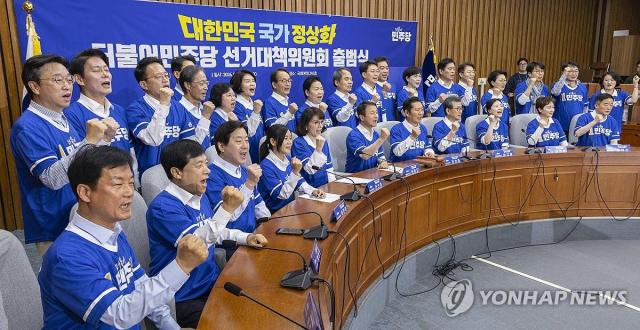
The Democratic Party's decision to streamline its central organization while strengthening regional structures reflects this understanding. It signals a commitment to shift the focus of the election from central politics to local realities. In fact, local elections are heavily characterized by competition over how to improve regional economies and living conditions. Voters tend to prioritize tangible changes over grand narratives.
The challenge lies not in the strategic direction but in its substance. More important than how the organization is structured is what policies and candidates will be put forward. Local governments are not merely auxiliary bodies of the central government; they are independent administrative entities. Remaining solely in a supportive role for the ruling party will not garner voter support. Tailored policies that consider the diverse economic situations, population structures, and industrial bases of each region must be presented.
The framing of the election is another critical factor. The Democratic Party interprets this election as a battle for the defense of democracy and political accountability. While this perspective holds some significance, it diverges from the essence of local elections. The issues that local voters face are related to jobs, housing, transportation, and education—practical matters of daily life. Political slogans alone cannot substitute for these demands. The message should be simple, but the content must be specific.
Ultimately, the core of the election is about practical politics. Key issues include how to revitalize the local economy, improve the lives of young people and small business owners, and address structural challenges such as population decline and industrial transition. While cooperation with the central government is necessary, failing to explain how it will bring about changes in the lives of local residents will diminish its persuasiveness.
Candidate competitiveness is also a significant variable. The Democratic Party has included individuals from diverse backgrounds in its committee, emphasizing "diversity and innovation." However, what is evaluated in elections is not symbolism but the ability to execute. Without verification of administrative experience, policy understanding, and moral integrity, the message will lose its impact. Voters no longer choose based solely on party affiliation.
The political environment also plays a role. In a context of heightened confrontation between the ruling and opposition parties, elections can easily devolve into partisan battles. However, approaching local elections in the same manner is not advisable. Local administration requires cooperation and coordination. If excessive confrontation is established during the election process, it may lead to burdens in administrative operations afterward.
What is required in this election is balance. There must be equilibrium between central and local, politics and administration, message and policy. Leaning too far in one direction can obscure the essence of the election. Particularly for the ruling party, it is essential to recognize that the weight of responsibility increases with the size of authority.
Jeong Cheong-rae's emphasis on "humility" ultimately connects to the attitude toward power. Humility must be proven through actions, not just words. A structure that accommodates diverse opinions in the policy-making process and genuinely reflects local voices must be created. Only then can trust in politics be enhanced.
While time is short, there is still enough to set a direction. What matters is not speed but substance. Elections are not just temporary events; they are processes that determine the future of regions. When the messages put forth by the Democratic Party translate into actual policies and actions, voter evaluations may change. Ultimately, this local election will be judged not by slogans but by capabilities.
* This article has been translated by AI.
Copyright ⓒ Aju Press All rights reserved.