

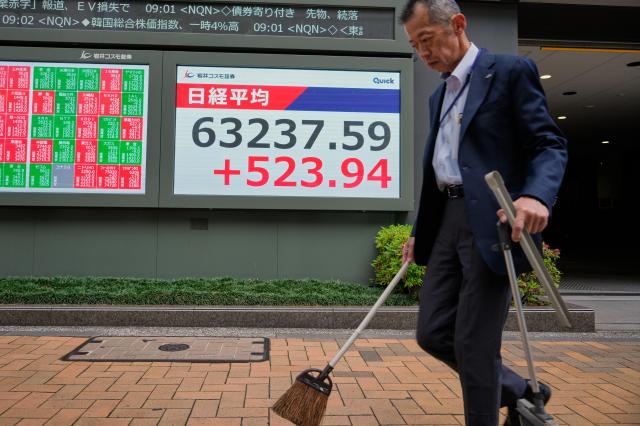
Japan's stock market is witnessing a shift in leadership. Once dominated by automotive and telecommunications companies, the market is now being led by semiconductors, banks benefiting from rising interest rates, and general trading companies with resource interests, all of which are capitalizing on the growing demand for artificial intelligence (AI).
On May 11, the Nikkei 225 index closed down 226.81 points (0.36%) at 62,486.84. The index opened at 63,203.44 and briefly rose to 63,385.04 during the day, but profit-taking led to a decline to 62,437.20, erasing earlier gains. This followed a record high closing on May 7, which contributed to the pressure at these elevated levels.
According to the Nihon Keizai Shimbun (Nikkei), the number of companies with market capitalizations exceeding 10 trillion yen (approximately $93.9 billion) rose to 27 as of May 8, an increase of four from the end of last year. At one point in mid-April, this number reached 30. As the base of Japan's large-cap stocks broadens, the focus has shifted from automobiles to semiconductors, banks, and trading companies.
The most notable change is in the semiconductor sector. Kioxia Holdings' market capitalization reached 24.2 trillion yen as of May 8, soaring more than 30 times from its initial public offering price of 784.3 billion yen in December 2024. Its ranking in market cap jumped from 43rd at the end of last year to 5th, surpassing major manufacturers like Hitachi and Keyence. The surge in NAND flash prices driven by AI demand has led to sharply revised profit forecasts for the fiscal year 2026 (April 2026 to March 2027). Companies related to AI and semiconductors, such as SoftBank Group, which invested in OpenAI, and semiconductor equipment firms like Tokyo Electron and Advantest, now occupy four of the top ten spots.
The revival of bank stocks is also noteworthy. The three major megabanks, including Mitsubishi UFJ Financial Group, have all surpassed a market cap of 10 trillion yen for the first time in nearly 20 years. Rising interest rates, which were once a burden during deflationary periods, are now seen as a catalyst for improved profitability, changing market perceptions. General trading companies like Mitsubishi Corporation are also gaining prominence amid inflation and fluctuating resource prices, boosting their market cap rankings.
The Nikkei highlights that rising prices are a key factor behind these changes. Tetsuro Ii, president of Commons Asset Management, stated, "The shift in Japan's economic trend from deflation to inflation is significant." As the long-standing deflationary period ends, companies find it easier to pass on rising costs and increased demand to prices, which in turn boosts expectations for revenue and profit growth, driving up stock prices. The semiconductor sector, with its soaring sales prices and rapidly expanding earnings due to strong AI investment, exemplifies this inflationary trend.
In contrast, the automotive sector, once a cornerstone of the Japanese stock market, is losing its prominence. Toyota Motor Corporation retains its top position with a market cap of 46 trillion yen, but the gap with second-place companies like SoftBank and Mitsubishi UFJ is narrowing. Following Toyota's forecast of a third consecutive year of declining net income for the fiscal year 2026, the market reacted with disappointment, pushing its stock price to a year-to-date low on May 8. All three major Japanese automakers—Toyota, Honda, and Nissan—now have price-to-book ratios (PBR) below 1. The automotive sector's share of the Tokyo Stock Exchange's TOPIX index has also fallen to 5.3%, a decline of 2 percentage points over the past year, marking its lowest level since 2000.
However, the Nikkei cautions that this shift in market capitalization does not necessarily indicate a restoration of Japan's stock market status. Over the past year, the growth rate of market capitalization in dollar terms has been 30.9% in the U.S. and 30.8% globally, compared to just 26.0% in Japan. Only three Japanese companies—Toyota, SoftBank Group, and Mitsubishi UFJ Financial Group—are included in the global top 100 by market cap, down from four a decade ago. As of the end of April, Japan's share of the MSCI All Country World Index (ACWI) stood at 5%, down from 7.7% ten years ago.
* This article has been translated by AI.
Copyright ⓒ Aju Press All rights reserved.