

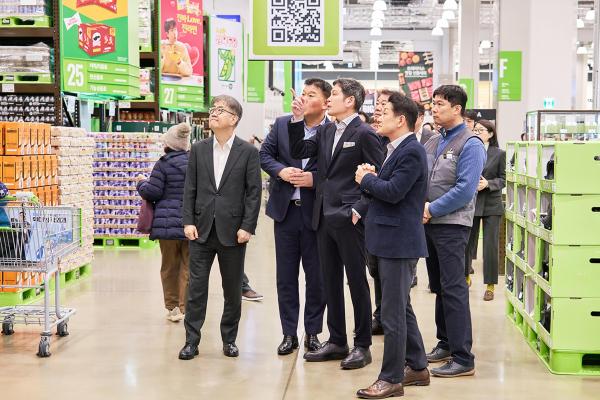
Shinsegae Group Chairman Jeong Yong-jin listens to a store and product briefing at the Traders Gukje store in Incheon in February. [Photo=Shinsegae Group]
As South Korea's leading discount retailers, Emart and Lotte Mart, report improved profitability for the first quarter, they are pursuing distinct strategies for continued growth this year. Emart is focusing on artificial intelligence (AI) commerce, while Lotte Mart is seeking opportunities in international markets and automation logistics infrastructure.
According to the retail industry on May 15, Shinsegae Group's Emart recorded an operating profit of 178.3 billion won for the first quarter, the highest figure for that period since 2012.
With improved profitability in its core business, Emart is expected to accelerate investments in future projects. Earlier this year, Shinsegae Group announced a partnership with U.S. AI company Reflection AI to implement AI commerce. Emart is anticipated to lead this transition within the group due to its extensive product offerings and customer interactions.
Shinsegae Group is also pursuing a project to build a 250 MW AI data center in South Korea in collaboration with Reflection AI. While specific locations and timelines have yet to be confirmed, both companies are reportedly discussing project directions through regular video conferences.
Once the transition to AI commerce is fully underway, Emart is expected to develop a model that connects product search, recommendations, payment, and delivery through conversational AI. This approach will shift from customers searching for products to AI suggesting items based on purchase intent, preferences, and price range. An Emart representative stated, "We will accelerate investments in future new businesses, including the construction of the AI data center, based on the growth of our existing operations."
Lotte Mart is looking for growth drivers abroad. The company reported an operating profit of 33.8 billion won for the first quarter, a 20.2% increase from the previous year, with international operations leading the improvement. Sales across all product categories increased steadily, particularly in Vietnam, where overseas operations generated an operating profit of 25 billion won.
With an 18% increase in sales from Vietnam driving overall international performance, Lotte Mart plans to continue leveraging its presence in Vietnam this year. Currently, Lotte Mart operates 15 stores in Vietnam and plans to open two new locations in the second half of the year.
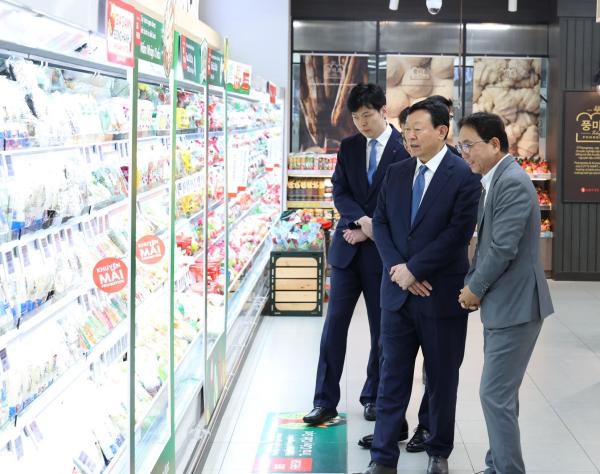
Shin Dong-bin, Chairman of Lotte Group, visits Lotte Mart at Lotte Mall Westlake Hanoi on April 23. [Photo=Lotte Holdings]
Shin Dong-bin, Chairman of Lotte Group, is also emphasizing the importance of the Vietnamese market. During a visit to Lotte Mall Westlake Hanoi on April 23, he remarked, "Vietnam is a key country for our global business, and it is encouraging to see growth in our core sectors such as food and retail."
Strengthening online grocery competitiveness is another growth avenue. Lotte Mart aims to launch its automated logistics center, the Busan Zeta Smart Center, in August, utilizing the smart platform from the UK’s Ocado. This center will feature AI and robotics to reduce the time from customer orders to product picking and delivery preparation. Following the center's opening, Lotte Mart plans to introduce early morning delivery and two-hour delivery services in the Busan and Gyeongnam regions to continue its performance improvement.
Meanwhile, the situation with Homeplus could also impact the profitability of Emart and Lotte Mart. Homeplus, currently undergoing corporate rehabilitation, has temporarily suspended operations at 37 stores until July 3. An industry insider noted, "Even if Homeplus resumes operations, if it cannot quickly recover its product assortment, many customers who switched to Emart and Lotte Mart may remain with them."
* This article has been translated by AI.
Copyright ⓒ Aju Press All rights reserved.