

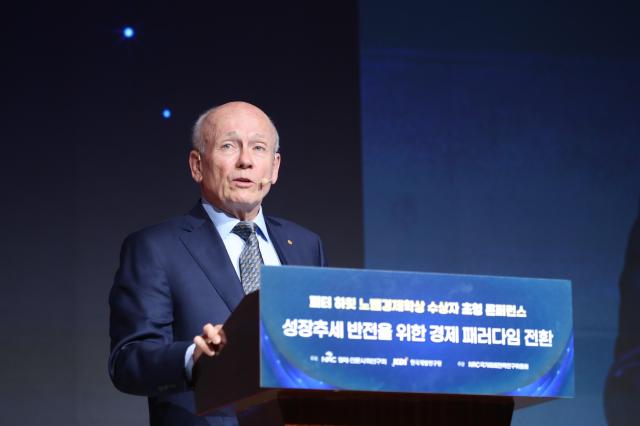
Peter Howitt, a professor at Brown University, delivers a keynote speech at the conference on economic paradigm shift for reversing growth trends, hosted by the Korea Development Institute (KDI) and the Economic and Social Research Institute, at the Westin Chosun Hotel in Seoul on May 15, 2026. [Photo: KDI]
The Korea Development Institute (KDI) and the Economic and Social Research Institute hosted a conference on May 15 at the Westin Chosun Hotel in Seoul, where Howitt delivered a keynote address on innovative growth strategies for the South Korean economy in the AI era.
Howitt diagnosed that the South Korean economy faces multiple challenges, including the spread of AI, rising protectionism, demographic changes, and the transition from follower to leading growth.
He defined AI as a “General Purpose Technology,” akin to electricity, electric vehicles, and personal computers, indicating that it is a technology that can reshape the entire economic structure rather than being confined to specific industries.
“General Purpose Technologies tend to go through initial disruption and prolonged adjustment periods before their productivity-enhancing effects spread across industries,” Howitt said. “To reap future benefits, all countries need to actively embrace this technology.”
He stressed the necessity for a comprehensive institutional redesign that encompasses education systems, social safety nets, and the stability of financial systems to respond to the spread of AI. He also highlighted the importance of collaborative industrial policies among government, businesses, and academia.
Howitt underscored the need to maintain an open economic system despite the rise of protectionism. “International trade enhances competitive pressure and provides access to global markets and learning opportunities, which fosters innovation,” he said, suggesting that South Korea should seek new trade alliances while also strengthening its domestic market in response to declining demand from existing trading partners.
Regarding the issue of population decline, he cautioned against excessive pessimism. “Population decline is not necessarily a constraint on growth, as some may fear,” he noted, adding that expanding selective immigration policies to attract talented individuals from abroad is a desirable direction.
Howitt proposed establishing a “leading growth system” as a key objective for South Korea's economic strategy. He stated that for the economy to transition to leading growth, a more innovative corporate ecosystem is needed, emphasizing the importance of strengthening support for small and medium-sized enterprises, expanding antitrust policies, and creating a technology-friendly financial system.
Concerns about the structural slowdown in the South Korean economy were prominently raised during the conference. Kim Se-jik, head of KDI, remarked, “It is time for a new growth strategy focused on ‘real growth’ rather than short-term economic responses,” referring to the trend of the economy experiencing a decline of 1 percentage point in growth rates every five years over the past three decades.
Deputy Prime Minister and Minister of Economy and Finance Ku Yun-cheol also emphasized in his congratulatory remarks the need for a shift from a follower-type economy to an innovation-driven transformation based on “creative destruction” to address external uncertainties such as the Middle East conflict and the structural issue of declining potential growth.
* This article has been translated by AI.
Copyright ⓒ Aju Press All rights reserved.