

North Korea's women's soccer team's visit to South Korea carries significance beyond a mere sports schedule. This marks the first time since 2018 that a North Korean team has played in South Korea, and it is the first women's soccer event since the 2014 Incheon Asian Games.
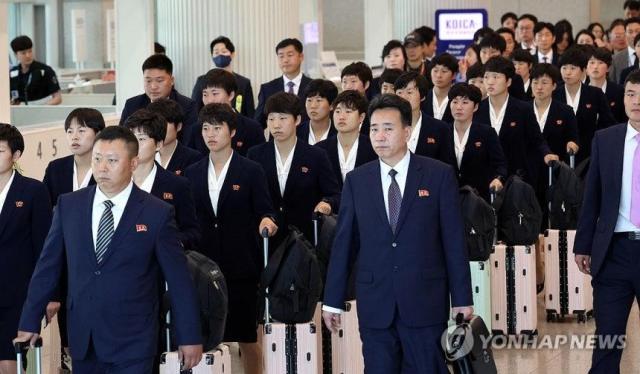
This visit, although framed as participation in an international tournament, is noteworthy as it represents a rare instance of 'restoring contact' amid strained inter-Korean relations.
The team is in South Korea to compete in the semifinals of the 2025-2026 Asian Football Confederation (AFC) Women's Champions League. The delegation consists of 39 members, including players and staff. Notably, this visit is not the result of political negotiations or intergovernmental agreements, which reduces the associated pressures. This aspect is crucial, as sports have historically served as a low-threshold channel for exchanges when inter-Korean relations are stalled.
In fact, inter-Korean sports exchanges have previously acted as catalysts for easing tensions on the Korean Peninsula. During the 2018 PyeongChang Winter Olympics, the formation of a unified Korean team and their joint appearance sent a strong symbolic message to the international community and contributed to a favorable atmosphere leading to subsequent summits. Even in times of political dialogue stagnation, sports have played a role as a 'pathway for contact.'
However, it is essential to avoid overinterpreting this visit. Currently, inter-Korean relations are characterized by accumulated military tensions and political distrust, nearing a state of effective severance. In a context marked by severed communication lines, military standoffs, and mutual accusations, it is unrealistic to expect that a single sports exchange will lead to improved relations. Past inter-Korean sports exchanges have often been abruptly halted due to changes in the political environment.
The key issue is 'sustainability.' If this visit ends as a one-time event, its significance will be limited. Conversely, if it serves as a foundation for maintaining and expanding minimal channels of exchange, the situation could change. While sports cannot resolve political conflicts, they can undoubtedly play a role in easing tensions and creating opportunities for dialogue.
To achieve this, a strategic approach from the government is necessary. It should not merely focus on welcoming ceremonies or event management but should consider a long-term roadmap that expands sports exchanges into cultural and humanitarian exchanges. In particular, regularizing exchanges through international competitions could be a realistic alternative. It is crucial to create a framework for exchanges that can be maintained relatively stably, rather than one that is susceptible to political fluctuations.
Another point to note is the potential for a change in North Korea's attitude. Observations of the team's travel routes, schedules, and external exposure suggest a degree of flexibility compared to the past. While this cannot be definitively interpreted as a policy change, it is our responsibility to read and leverage signals of change. Inter-Korean relations can significantly shift based not only on the other side's changes but also on our responses.
Ultimately, the essence of inter-Korean relations lies in political and security issues. Sports exchanges alone cannot resolve structural conflicts. However, it is clear that maintaining limited contact is far more manageable than a complete severance of exchanges.
This visit serves as a reminder of that 'small link.'
This visit serves as a reminder of that 'small link.'
The government must not let this opportunity slip away. Inter-Korean relations will not improve through one-off events. Trust is built when small exchanges are repeated and accumulated. The visit of the North Korean soccer team highlights the existence of potential. Whether that potential becomes a reality ultimately depends on our strategy and will.
* This article has been translated by AI.
Copyright ⓒ Aju Press All rights reserved.