

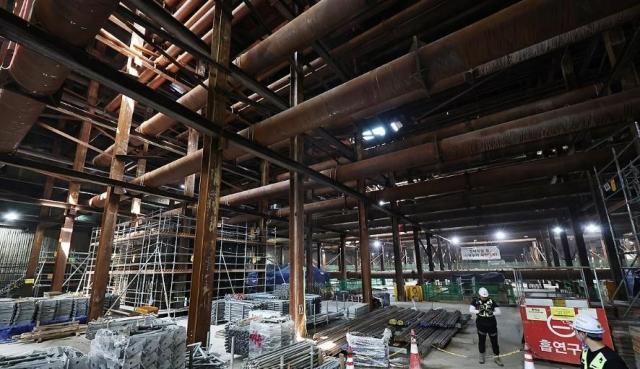
The fallout from a significant steel rebar shortage at the Samsung Station transfer center, a key hub for the GTX-A line, is intensifying. To prevent self-verification by the construction company and the project owner, the government plans to engage an external professional organization to reassess the reinforcement methods from scratch. This comes amid escalating blame between the Ministry of Land, Infrastructure and Transport, the Seoul Metropolitan Government, and Hyundai Engineering & Construction over a five-month delay in reporting the construction error, raising concerns about the planned full opening of the GTX-A line (non-stop passage through Samsung Station) later this year.
According to the construction and railway industries on May 18, the Ministry of Land is considering appointing external organizations, including professional societies, to verify the reinforcement methods for the Samsung Station transfer center's columns, aiming to eliminate any potential influence from the project owner and construction company and ensure the objectivity of structural safety verification.
A ministry official stated, "We plan to review not only the steel plate reinforcement method proposed by Hyundai Engineering & Construction but also alternative methods."
Currently, Hyundai Engineering & Construction is proposing a method that involves attaching and welding steel plates to the outer walls of the columns as the most viable reinforcement approach. They argue this method is efficient, allowing for early structural stability while minimizing construction time.
Hyundai Engineering & Construction explained, "We proactively identified the steel rebar shortage in the columns of the underground fifth floor during our quality screening process last November and immediately notified the Seoul Metropolitan Government. Since then, we have been collaborating with the city to develop a reinforcement method and have been waiting for the city’s decision regarding the implementation of this method."
On the same day, the Ministry of Land deployed a special inspection team consisting of 12 external experts from organizations such as the Korea Safety Management Agency and the Korea Railroad Research Institute to the site. Under the Construction Technology Promotion Act, they plan to conduct a thorough investigation of all aspects of construction, safety, and quality management for the underground complex development project on Yeongdong-daero over the next month. If any illegal activities are confirmed, measures such as penalties against Hyundai Engineering & Construction are being considered.
There are interpretations within and outside the government that the Ministry of Land views this incident not merely as a construction error but as a failure in project management, given that it delayed official reporting for about five months after identifying the steel rebar shortage last November. The ministry has initiated an audit concerning the circumstances surrounding this delay, targeting the Seoul Metropolitan Government and the Korea Railroad Corporation.
In response, the Seoul Metropolitan Government has denied allegations of concealment, asserting that there were no procedural issues. They stated in a briefing that they submitted construction management reports, which included the relevant issues, to the Korea Railroad Corporation three times between November of last year and January of this year, following the procedures outlined in the construction management agreement.
The Seoul government also noted, "The structural engineer's review confirmed that there are currently no issues with the load capacity," adding that they shared the final reinforcement plan with the Ministry of Land at the end of April after confirming safety and construction feasibility.
As the government has decided not to accept Hyundai Engineering & Construction's reinforcement method outright and will instead reassess alternative methods through a professional society, the company's internal schedule for a '10-week steel plate reinforcement project' is likely to be significantly altered.
The additional time required for appointing external professional societies and the verification service overlaps with the Ministry of Land's special inspection period, increasing the likelihood of delays in the start of the reinforcement work itself. If subsequent facility verification tests and operational trials are also delayed, the Ministry's target for non-stop passage through Samsung Station later this year may be pushed back to after the end of the year.
A construction industry insider remarked, "This is not simply a 10-week reinforcement project; the government is calling for a complete reassessment of the method itself, which could impact the scheduled official opening of Samsung Station set for the end of 2028."
According to the construction and railway industries on May 18, the Ministry of Land is considering appointing external organizations, including professional societies, to verify the reinforcement methods for the Samsung Station transfer center's columns, aiming to eliminate any potential influence from the project owner and construction company and ensure the objectivity of structural safety verification.
A ministry official stated, "We plan to review not only the steel plate reinforcement method proposed by Hyundai Engineering & Construction but also alternative methods."
Currently, Hyundai Engineering & Construction is proposing a method that involves attaching and welding steel plates to the outer walls of the columns as the most viable reinforcement approach. They argue this method is efficient, allowing for early structural stability while minimizing construction time.
Hyundai Engineering & Construction explained, "We proactively identified the steel rebar shortage in the columns of the underground fifth floor during our quality screening process last November and immediately notified the Seoul Metropolitan Government. Since then, we have been collaborating with the city to develop a reinforcement method and have been waiting for the city’s decision regarding the implementation of this method."
On the same day, the Ministry of Land deployed a special inspection team consisting of 12 external experts from organizations such as the Korea Safety Management Agency and the Korea Railroad Research Institute to the site. Under the Construction Technology Promotion Act, they plan to conduct a thorough investigation of all aspects of construction, safety, and quality management for the underground complex development project on Yeongdong-daero over the next month. If any illegal activities are confirmed, measures such as penalties against Hyundai Engineering & Construction are being considered.
There are interpretations within and outside the government that the Ministry of Land views this incident not merely as a construction error but as a failure in project management, given that it delayed official reporting for about five months after identifying the steel rebar shortage last November. The ministry has initiated an audit concerning the circumstances surrounding this delay, targeting the Seoul Metropolitan Government and the Korea Railroad Corporation.
In response, the Seoul Metropolitan Government has denied allegations of concealment, asserting that there were no procedural issues. They stated in a briefing that they submitted construction management reports, which included the relevant issues, to the Korea Railroad Corporation three times between November of last year and January of this year, following the procedures outlined in the construction management agreement.
The Seoul government also noted, "The structural engineer's review confirmed that there are currently no issues with the load capacity," adding that they shared the final reinforcement plan with the Ministry of Land at the end of April after confirming safety and construction feasibility.
As the government has decided not to accept Hyundai Engineering & Construction's reinforcement method outright and will instead reassess alternative methods through a professional society, the company's internal schedule for a '10-week steel plate reinforcement project' is likely to be significantly altered.
The additional time required for appointing external professional societies and the verification service overlaps with the Ministry of Land's special inspection period, increasing the likelihood of delays in the start of the reinforcement work itself. If subsequent facility verification tests and operational trials are also delayed, the Ministry's target for non-stop passage through Samsung Station later this year may be pushed back to after the end of the year.
A construction industry insider remarked, "This is not simply a 10-week reinforcement project; the government is calling for a complete reassessment of the method itself, which could impact the scheduled official opening of Samsung Station set for the end of 2028."
* This article has been translated by AI.
Copyright ⓒ Aju Press All rights reserved.