

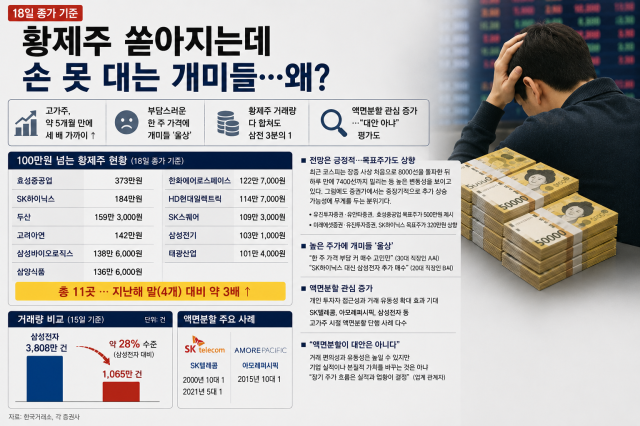
As the KOSPI index continues to reach record highs, the number of so-called "emperor stocks," which have prices exceeding 1 million won, has also surged. However, the soaring prices have made these stocks less accessible for individual investors.
According to the Korea Exchange, as of May 18, the closing prices for companies such as Hyosung Heavy Industries, SK Hynix, Doosan, Korea Zinc, Samsung Biologics, Samyang Foods, Hanwha Aerospace, HD Hyundai Electric, SK Square, Samsung Electro-Mechanics, and Taekwang Industrial have reached a total of 11 companies. This marks an increase from four companies at the end of last year, nearly tripling in just five months, which is the highest level on record.
Market analysts are optimistic about the potential for further gains among these emperor stocks. Eugene Investment & Securities and Yuanta Securities have set a target price of 5 million won for Hyosung Heavy Industries, citing an expansion in new orders. Mirae Asset Securities and Eugene Investment & Securities have raised their target price for SK Hynix to 3.2 million won, based on improvements in the memory market and increased profitability.
However, not all individual investors view the rising stock prices positively. A 30-year-old office worker, referred to as A, stated, "Many predict that SK Hynix will continue to rise, but the price per share is daunting. I find myself only contemplating buying without making a decision." Another office worker in their 20s, B, mentioned, "I can't afford to buy SK Hynix right now, so I opted to purchase more Samsung Electronics instead."
This trend is reflected in trading volumes as well. As of May 15, Samsung Electronics had a trading volume of 38.08 million shares, while the combined trading volume of the 11 emperor stocks was only about 10.65 million shares. This means that the total trading volume of emperor stocks was only about 28% of that of Samsung Electronics.
Due to these circumstances, there is growing interest in the possibility of stock splits. A stock split increases the number of shares without changing the company's value or market capitalization, effectively lowering the price per share. This is seen as a way to enhance accessibility for individual investors and increase trading liquidity. Notable examples of companies that have executed stock splits during high price periods include SK Telecom (10-for-1 in 2000 and 5-for-1 in 2021), Amorepacific (10-for-1 in 2015), and Samsung Electronics (50-for-1 in 2018).
However, some market participants caution against placing too much significance on stock splits. While they can improve trading convenience and liquidity, they do not alter a company's performance or intrinsic value. An industry insider remarked, "A stock split does not change the fundamentals of a company. Ultimately, long-term stock price trends are determined by performance and market conditions."
* This article has been translated by AI.
Copyright ⓒ Aju Press All rights reserved.