

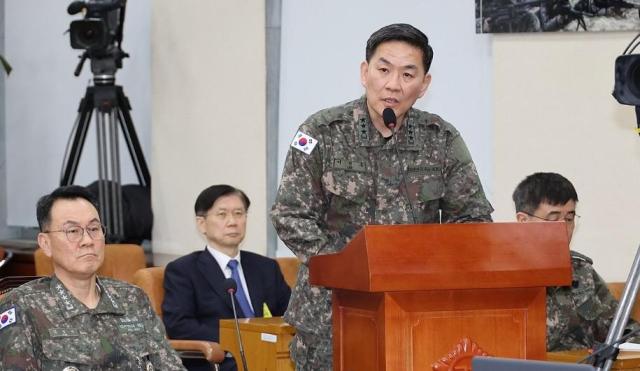
During the emergency declaration on December 3, 2024, the former legal chief of the Capital Defense Command expressed doubts about its constitutionality upon reading the official statement.
On May 18, at the Seoul Central District Court, the trial of former Commander Lee Jin-woo, who faces charges related to insurrection, continued. Colonel Moon Sang-won, the former legal chief of the Capital Defense Command and current head of the Gangwon Regional Army Prosecutor's Office, testified about the events surrounding the emergency declaration.
Before his testimony, Colonel Moon stated that he found it difficult to face his former superior, Commander Lee. In response, the court installed a partition between the witness stand and the defendant's seat to prevent them from seeing each other. Colonel Moon began his testimony only after confirming the partition was in place.
During questioning by the special prosecution team, Colonel Moon recounted the situation during the emergency declaration, stating, "After the emergency was declared, I received a notification for an emergency assembly and encountered the presidential statement and the first emergency proclamation through news from portal sites while in a taxi heading to the unit."
He added, "The content of the statement cited legislative dictatorship and anti-state actions as justifications, but as a legal professional, I had serious doubts about its constitutionality and legality." He specifically noted that the first article of the proclamation, which banned all political activities of the National Assembly and local councils, was particularly perplexing, as it seemed to violate the principle of separation of powers.
Upon arriving at the unit, Colonel Moon headed to the command and control center but did not encounter Commander Lee there. He testified that orders had already been issued to deploy troops to the National Assembly, and the situation was extremely chaotic. "It was confusing to determine where the orders were coming from, whether from the Army Headquarters, the Joint Chiefs of Staff, or somewhere in Yongsan," he said.
The special prosecution team engaged in a debate with Commander Lee's defense regarding the legality of deploying Capital Defense Command troops to the National Assembly. They pressed Colonel Moon on whether the command's general operational manuals or training for hybrid warfare included directives for blocking the National Assembly or arresting lawmakers.
Colonel Moon responded, "I have never seen any content in the Capital Defense Command manuals that involves sending troops to the National Assembly for large-scale infiltration or responding to lethal weapons." He also stated he did not recall any mention of supporting counterintelligence operations for joint investigations or arrests during the emergency situation.
In contrast, Commander Lee's defense argued that the Capital Defense Command's mission primarily focused on responding to terrorism at key facilities in Seoul, and that the legal chief mainly handled disciplinary or administrative tasks, thus lacking knowledge of operational terminology or specific situations. Colonel Moon countered, saying, "If legal terminology is involved, it is my duty as an expert to verify and provide advice."
Furthermore, Commander Lee's attorney claimed that testimonies from former Capital Defense Command 1st Security Battalion Commander Jo Sung-hyun and others, who stated they received orders to arrest lawmakers, were unreliable, asserting that Commander Lee was focused on maintaining control of the command center and dismissed any claims of arrest orders as perjury.
However, Colonel Moon supported Commander Jo's testimony, stating, "Commander Jo considers his subordinates like family, and I want to emphasize that the accounts of the subordinates who were in the car during the deployment to the National Assembly are likely accurate."
In closing, Colonel Moon shared a personal story about how his father, originally from Masan, Gyeongnam, passed down a tie he wore during the June Democratic Uprising in 1987. He remarked, "My father believed that because of the events in Gwangju in May 1980, we were able to safely protest and achieve direct elections in June 1987. The past helps the present, and the dead assist the living. I hope this trial becomes a beacon of light for our democracy," before leaving the courtroom.
The court plans to make a final judgment on Commander Lee's involvement in the insurrection based on further witness testimonies and evidence regarding Commander Jo and other related individuals.
* This article has been translated by AI.
Copyright ⓒ Aju Press All rights reserved.