

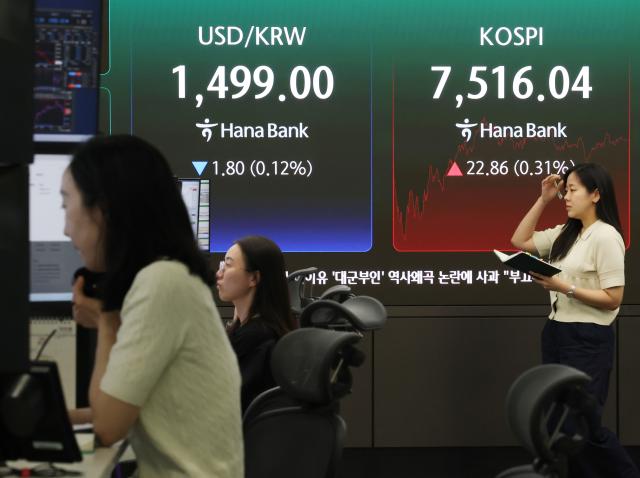
The South Korean stock market experienced another severe "rollercoaster" day on May 18. Fears of rising interest rates from the U.S. led to a sharp drop in the early trading session, prompting concerns of a "Black Monday" akin to last week's "Black Friday." However, the fear of rising rates did not deter individual investors, who have made over 32 trillion won in net purchases over the past eight trading days. On this day, they contributed more than 2 trillion won in buying, helping to lift the index.
Despite the rebound, the overall market sentiment remained subdued. Among the 948 stocks listed on the KOSPI, only 203 saw gains, while 688 declined, with 57 remaining unchanged. Notably, 110 stocks fell by more than 5%, indicating a more significant perceived loss.
Nevertheless, individual investors aggressively pursued bargain buying. According to the Korea Exchange, they net purchased 2.2 trillion won in the stock market alone on this day. In contrast, foreign investors sold off 3.65 trillion won, while institutional investors bought 1.39 trillion won.
Over the last eight trading days, individual investors' net purchases totaled 32.69 trillion won, while foreign investors sold off 35.73 trillion won during the same period. On May 15 alone, individual net purchases reached 7.23 trillion won. As the market continues to decline, individual investors are increasingly intensifying their bargain buying efforts.
However, there are concerns that continued market declines could lead to increased risks of forced selling. According to the Korea Financial Investment Association, as of May 15, the amount of margin loans stood at 1.54 trillion won, with forced selling amounting to 37.5 billion won. Analysts suggest that if the index continues to fall, the volume of forced selling could increase, exacerbating the downward trend.
While individual investors are actively engaging in bargain buying, some investors who bet on a market decline are facing significant losses. The KODEX 200 Futures Inverse 2X, a popular inverse product, recorded a -40.70% return over the past month. Similarly, the TIGER 200 Futures Inverse 2X posted a 40.48% loss during the same period. The repeated rebounds following sharp declines have also worsened the returns for those betting on a downturn, with the last two trading days showing returns of -1.7% and -1.6%, respectively.
Analysts identify the surge in U.S. Treasury yields as a key factor driving volatility in global markets. The yield on the U.S. 10-year Treasury has surpassed 4.5%, while the 30-year yield has exceeded 5%, leading to a rapid spread of risk-averse sentiment. Concerns over the prolonged conflict in the Middle East and inflation pressures from rising oil prices are also contributing to market unease.
The South Korean stock market has been affected by increased foreign selling, but semiconductor stocks have provided some support. As Samsung Electronics turned upward during trading, the KOSPI managed to reduce its losses and eventually reversed course. Analysts predict that the domestic market will continue to experience high volatility in the near term, influenced by U.S. interest rate trends, geopolitical developments in the Middle East, and labor issues at Samsung Electronics.
Han Ji-young, a researcher at Kiwoom Securities, stated, "The market is expected to be exposed to macro uncertainties. The upcoming earnings results from NVIDIA, scheduled for later this week, could be a pivotal moment for improving market sentiment, particularly for semiconductor stocks."
Seo Sang-young, a researcher at Mirae Asset Securities, noted, "The decline in the KOSPI was significantly reduced when Samsung Electronics turned upward amid news surrounding its labor issues. However, the recent surge in Treasury yields is likely to continue, making increased volatility in global markets inevitable."
* This article has been translated by AI.
Copyright ⓒ Aju Press All rights reserved.