

Concerns over inflation are escalating globally, pushing government bond yields to their highest levels in years. Analysts suggest that future interest rates will largely depend on international oil prices.
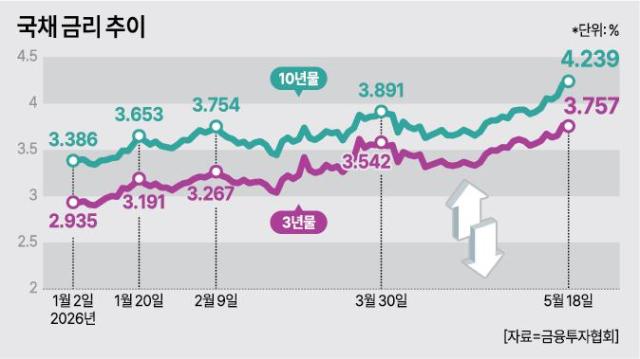
According to the Korea Financial Investment Association, on May 18, the yield on three-year government bonds closed at 3.757%, while the yield on ten-year bonds reached 4.239%. This ten-year yield is the highest since October 13, 2022, when the "Legoland incident" occurred. In May alone, yields have risen by 16.2 basis points for three-year bonds and 31.6 basis points for ten-year bonds.
The rise in South Korean government bond yields reflects growing inflation concerns. Sustained high oil prices have driven up energy supply costs, increasing upward pressure on prices, while the economy is performing better than expected.
As a result, the Bank of Korea is increasingly likely to shift its monetary policy toward raising interest rates, a sentiment that is being reflected in the market. Additionally, there is heightened caution regarding government bond auctions, further complicating the situation.
External factors are also influencing bond yields. Following a U.S.-China summit that yielded no significant outcomes, international oil prices have surged past $100 per barrel. Brent crude futures for July delivery have risen to $110 per barrel on the ICE Futures Exchange, while West Texas Intermediate (WTI) futures for June delivery have also surpassed $100 per barrel. This increase is attributed to concerns over stalled peace negotiations between the U.S. and Iran.
Yields on government bonds in major economies are also climbing sharply. The rise in international oil prices has intensified inflationary pressures, leading to widespread concerns about central bank tightening. According to the CME FedWatch, the interest rate futures market reflects a 41.7% probability that the Federal Reserve will raise interest rates by December.
The yield on the benchmark U.S. 10-year Treasury note reached 4.597% on May 15 and has remained above 4.6% as of May 18. The yield on the two-year U.S. Treasury note, which is sensitive to monetary policy, is above 4.10%, while the 30-year Treasury yield has exceeded 5.14%, marking its highest level since 2007.
Japanese government bond yields have also surged, contributing to global bond market anxiety. Following an unexpected rise in Japan's inflation rate in April, the yield on 10-year Japanese government bonds has climbed to around 2.7%, the highest level in 29 years since 1997. In the UK, bond yields have reached multi-decade highs as a pro-expansion prime ministerial candidate emerges.
Experts predict that the current surge in yields is unlikely to reverse anytime soon. Im Jae-kyun, a researcher at KB Securities, stated, "Despite a significant rise in yields, the government intervened verbally on May 15, but the Bank of Korea has shifted toward raising interest rates. Concerns about supply and demand are also emerging, making it difficult for market anxiety to ease quickly."
Ultimately, international oil prices are seen as a key variable influencing future interest rate directions. Ahn Ye-ha, a researcher at Kiwoom Securities, noted, "Given the structural challenges in resolving the increased duration premium due to expanded fiscal burdens in major countries, market interest rates can only shift direction if oil prices decline significantly. This indicates that unless geopolitical uncertainties are resolved, volatility is likely to persist."
* This article has been translated by AI.
Copyright ⓒ Aju Press All rights reserved.