

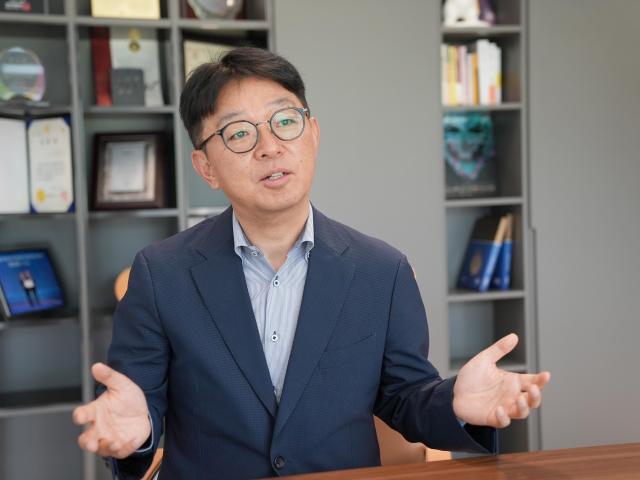
"While many biotech companies focus on technology licensing, Kurosel aims to grow as a company that generates its own revenue," said Kim Geon-soo, CEO of Kurosel, in a recent interview at the company's headquarters in Yuseong-gu, Daejeon.
CAR-T therapy is a personalized gene therapy that genetically modifies a patient's immune cells to precisely target cancer cells. Limcato (ingredient name: Anbalcaptagen autoleucel) is Korea's first CAR-T therapy and was granted product approval by the Ministry of Food and Drug Safety on April 29. The company plans to use Limcato's approval as a stepping stone for both domestic market establishment and global expansion.
Kurosel has set several records as a pioneer in the history of CAR-T therapy in South Korea. In 2021, it received approval for the country's first CAR-T clinical trial application (IND) and administered the first CAR-T treatment to a patient. In 2023, the company established the largest commercial CAR-T Good Manufacturing Practice (GMP) production facility in Daejeon, laying the groundwork for commercialization.
Below is a Q&A with CEO Kim.
- Starting from a situation where there was virtually no CAR-T infrastructure in Korea, you have reached the point of having the 'first domestic CAR-T.' Wasn't it particularly challenging?
"The most difficult part was the lack of experience with CAR-T in Korea. There were no clinical research organizations (CROs), and even the essential materials for drug development were not reliably available domestically. We essentially started from scratch. Nevertheless, our goal was clear: to create a treatment that is better than global products, not just Korea's first CAR-T. I co-founded Kurosel with Professor Kim Chan-hyuk from KAIST and Professor Shim Hyun-bo from Ewha Womans University, whom I had never met before, but we quickly aligned on our vision."
- There is great anticipation in being able to produce and supply CAR-T therapy domestically.
"Until now, many CAR-T therapies used in Korea involved sending patient cells to overseas factories for production and then bringing them back, which could take over a month. For patients with relapsed or refractory hematologic cancers, missing the treatment window can lead to rapid deterioration. Reducing the manufacturing time is not just about production efficiency; it directly impacts survival. Kurosel has established a domestic production system based on our Daejeon CAR-T dedicated GMP facility."
- Your proprietary OVIS platform is mentioned as a differentiating technology.
"The OVIS platform is our self-developed technology for controlling immune suppression signals. Typically, immune cells (T-cells) experience 'exhaustion' during the process of attacking cancer cells. OVIS can reduce T-cell exhaustion based on platform technology that simultaneously inhibits PD-1 and TIGIT."
- How do you view the market potential and business viability of Limcato?
"In Korea, approximately 4,000 patients with relapsed or refractory diffuse large B-cell lymphoma (DLBCL) are diagnosed each year, and those who do not respond to existing treatments become candidates for CAR-T therapy. We estimate that around 700 to 1,000 patients will be eligible annually. Even if we share the market with competing products, securing just 300 patients under health insurance coverage could generate about 90 billion won in revenue. We believe this is a sufficiently meaningful scale for business (currently, the reimbursement price for Kimriah is about 360 million won). Importantly, our focus is on investing in ongoing research and development (R&D) to grow the company rather than seeking short-term profits."
- As a latecomer in the global CAR-T market, how will you prove your competitiveness?
"CAR-T is a treatment administered once in a lifetime. For patients, it is a single choice, so the most critical factors are treatment efficacy and safety. Limcato achieved a complete response rate (CR) of 67.1% in clinical trials, which we believe is competitive compared to Kimriah (about 40%), Yescarta (about 54-58%), and Breyanzi (about 53%). Hospitals and medical professionals ultimately rely on objective data. The key is which drug can more effectively eliminate cancer cells and prolong patient survival."
- What is the production capacity of the Daejeon GMP facility, and what are your future plans for its utilization?
"Currently, the maximum manufacturing period is 16 days, with the capacity to produce about 700 treatments annually. If needed, we can expand this capacity to double. We can adequately cover DLBCL at this time. Recently, there has been growing interest in the potential of CAR-T for treating autoimmune diseases in the global market. Conditions like systemic lupus erythematosus (SLE) are areas of focus, and we believe this could be feasible within the next 3 to 5 years."
- What direction is Kurosel aiming for?
"We aspire to be a company that grows steadily based on our own revenue. Rather than packaging the company based on the number of technology exports, we aim to solidify our foundation. Many view Kurosel as the leading company in CAR-T in Korea, but we intend to gradually build our strength and capabilities, expanding from the domestic market to the global stage."
* This article has been translated by AI.
Copyright ⓒ Aju Press All rights reserved.