

The 2026 local elections indicate that South Korean politics is on the brink of an "AI election" era. In the past, campaigns were conducted through rallies, market visits, TV debates, and newspaper editorials. Candidates appealed for support in person, while voters made judgments based on print and broadcast media. Democracy moved slowly, but at least it operated within a shared reality where it was generally possible to verify who said what, which scenes were real, and what constituted the truth.
However, today's elections unfold in an entirely different arena—within algorithms rather than public squares.
During this local election cycle, the National Election Commission has initiated special measures to combat the distribution of AI deepfake videos. Videos that synthesize the faces and voices of actual candidates have spread across social media and YouTube, prompting the commission to report these incidents to the police. This is no mere prank; it signals that AI technology is beginning to disrupt the information order of democracy.
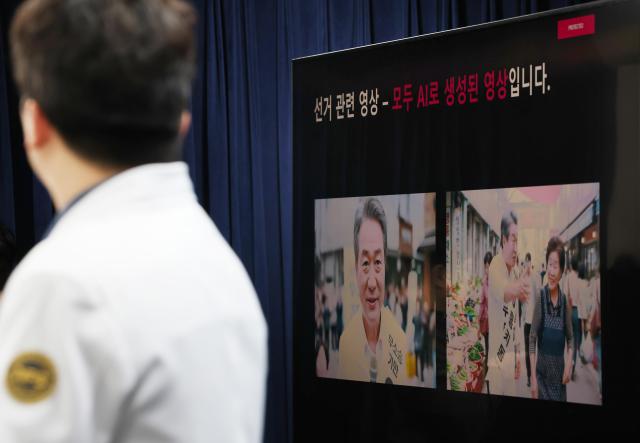
Yet, the essence of the issue is not the deepfakes themselves. A more significant change is that democracy has fully entered the marketplace of the "attention economy." Economically, the core asset of platform companies is not their factories but people's time. Platforms like YouTube, TikTok, and Instagram generate revenue by selling user engagement. The problem is that content that captures human attention the longest is not always truthful or balanced. Outrage, hatred, fear, and shock spread much faster than nuanced explanations.
Policy is slow. Stimuli are fast.
Voters may not read a candidate's detailed policy proposals, but a short video mocking an opponent can quickly rack up millions of views. A single line of conspiracy theory can be more powerful than complex local financial policies. Democracy is shifting from a deliberative process to a competition of emotional speed.
AI exacerbates this trend.
In the past, propaganda and manipulation required substantial resources—broadcasting stations, organizations, and funding. Now, all that is needed is generative AI and a smartphone. Voice replication can be achieved in seconds, and video synthesis has become accessible to the average user. The barriers to political manipulation have effectively vanished.
The world is already experiencing these dangers. In the United States, ahead of the 2024 election, AI-generated robocalls mimicking President Joe Biden's voice circulated among voters, urging them not to vote. The Federal Communications Commission (FCC) imposed hefty fines on the political consultant responsible. Early in the Ukraine war, a deepfake video falsely depicting President Volodymyr Zelenskyy declaring surrender was disseminated. In India, AI avatars of politicians campaigned in multiple languages, while in the Philippines, AI-generated political messages emerged.
South Korea faces particularly perilous conditions. The combination of world-class digital infrastructure, a rapid information consumption culture, a YouTube-centric political consumption structure, and declining trust in traditional media creates a perfect storm for elections to increasingly shift toward "platform politics."
This raises a crucial question: Is YouTube a media outlet or a platform? They often claim, "We are just a technology platform." However, in reality, YouTube has become the largest political media outlet in the world, surpassing television in influence and outpacing newspapers in dissemination speed. Yet, like traditional media, it bears little public responsibility.
This is the fundamental contradiction of platform capitalism. While railroads, electricity, and telephone networks served as the infrastructure of the industrial age, algorithms now constitute social infrastructure. The problem is that this infrastructure operates on the logic of advertising revenue rather than the public good of democracy. Platforms are fundamentally industries of engagement; the longer users stay, the more advertising revenue increases. Consequently, algorithms naturally favor emotionally charged content, as outrage and hatred are consumed longer than discussions.
French philosopher Jean Baudrillard referred to modern society as the age of "simulacra," where replicated images become more powerful than originals. The era of AI deepfakes exemplifies this prophecy. Manipulated candidate images can become a stronger political reality than the actual candidates.
More dangerously, people are becoming increasingly desensitized to the question of "what is real?" As deepfakes proliferate, citizens may end up doubting all information. The problem is that at this moment, the "common reality" that underpins democracy begins to crumble. If society cannot discuss the same facts, politics devolves into a war of fandoms.
At this juncture, it is essential to recognize that this issue should not be viewed merely as a "technological side effect." The essence lies in the market structure.
Platforms are not public institutions; they are advertising companies. Therefore, relying solely on self-regulatory ethics has its limits. In fact, the European Union (EU) is strengthening regulations on platform algorithm accountability and political advertising transparency through the Digital Services Act (DSA). There is a growing trend to mandate labeling of AI-generated content and to monitor recommendation algorithms.
Ultimately, the question shifts from technology to rules. The challenge for democracy in the AI era is how to balance "freedom of expression" with "information trustworthiness." Complete censorship is dangerous, but total neglect could be even more perilous. The belief that the market can solve all problems also reveals its limitations here, as the revenue structure of platforms is designed to favor sensationalism and dissemination.
Thus, what is needed moving forward is not merely a moral appeal but institutional design. First, there is a need to strengthen the obligation to watermark AI-generated political content during election periods. Second, minimum transparency for platform recommendation algorithms should be required. Third, a rapid removal system for political deepfakes must be institutionalized. Fourth, education on digital literacy across schools and society is urgent.
In the future, a citizen's core competency may not be the ability to consume vast amounts of information but rather the ability to discern what has been manipulated.
Businesses face similar challenges. In the AI era, a company's key asset will ultimately be trust. Global companies are already establishing AI risk management teams to address the risks of fake CEO statements, manipulated videos, and false advertising. In the future, a company's crisis management capabilities are likely to hinge more on managing digital trust than on factory operations.
The media must also adapt.
In the AI era, mere competition for breaking news will not suffice for survival. AI can produce breaking news faster. The true competitiveness of the media lies in verification, interpretation, context, and trust. It has become more important to accurately explain reality than to be the first to report.
Importantly, there is no need to view technology itself as evil. AI also has the potential to make democracy more open, enhancing political accessibility for the disabled and elderly, broadening policy understanding through multilingual translation, and increasing local community participation.
The issue is not technology but philosophy. What rules, ethics, and public values will be established on top of it?
This local election signifies more than just a reconfiguration of local power. It is a test of whether South Korean democracy will uphold deliberative democracy or slip into algorithmic democracy.
Democracy was originally a system that trusted human reason. However, the age of AI and platforms stimulates human emotions and instincts much more rapidly. The question South Korean society must confront now is this:
Will we make AI a tool for democracy, or will we accept a future where democracy becomes a product of AI algorithms?
* This article has been translated by AI.
Copyright ⓒ Aju Press All rights reserved.