

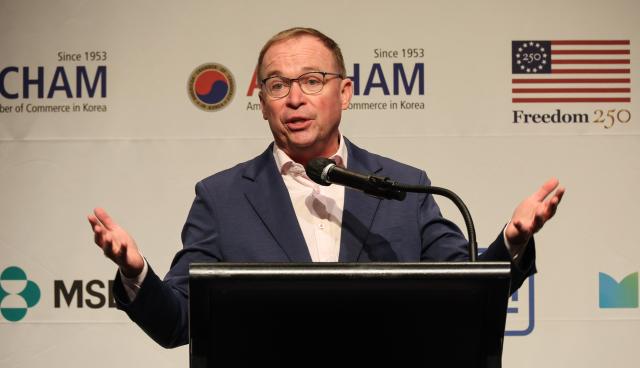
SEOUL, May 21 (AJP) - Mick Mulvaney, the former acting White House Chief of Staff, stated that many of the changes occurring in Washington today are not limited to President Trump but represent structural trends that will shape the U.S. political and economic order in the long term.
He also noted that protectionism and a domestic-focused economic policy are likely to remain central to U.S. policy regardless of which party is in power.
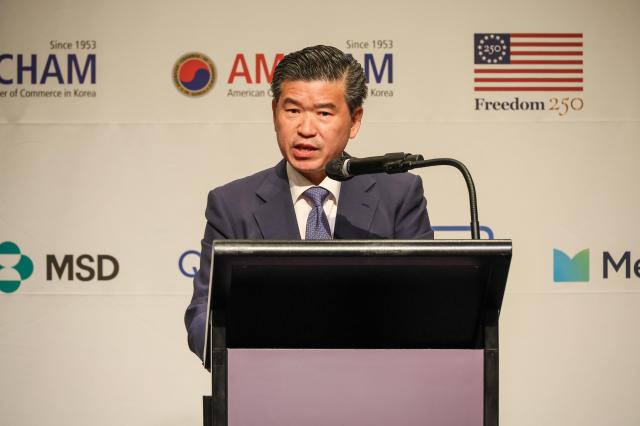
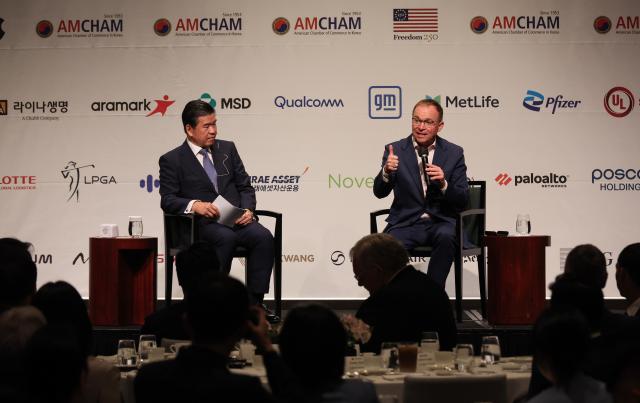
The American Chamber of Commerce in Korea (AMCHAM) hosted a special luncheon on May 21 at the Grand Hyatt Hotel in Yongsan, Seoul, featuring Mulvaney as a guest speaker.
The event, titled 'The Return of America First: Global Business and Geopolitics in the Trump 2.0 Era,' included a one-on-one discussion between AMCHAM Chairman and CEO James Kim and Mulvaney, attended by over 120 members and representatives from major domestic and international companies.
Participants discussed the policy direction of a potential second Trump administration, changes in U.S. trade and industrial policy, tariff policies, reshoring strategies, geopolitical risks concerning the Middle East and North Korea, and the restructuring of global supply chains focused on economic security. They also explored ways to enhance U.S.-Korea cooperation in strategic industries such as semiconductors, shipbuilding, energy, artificial intelligence (AI), and advanced manufacturing.
Mulvaney served in various roles during the Trump administration, including acting White House Chief of Staff, Director of the Office of Management and Budget (OMB), and acting Director of the Consumer Financial Protection Bureau (CFPB). He elaborated on the decision-making processes and leadership style of the Trump administration, as well as the impact of the 'America First' policy on U.S. domestic politics, foreign policy, and the global economic order.
He remarked that there is a growing fatigue regarding long-term foreign interventions in American society, and inflationary pressures are expected to persist for some time. He added that government intervention in strategic industries and the private market is likely to increase, emphasizing that these trends represent structural changes that will affect U.S. economic, industrial, and trade policies for years to come.
Having reported daily to President Trump and met with him nearly 20 times a day, he described Trump as someone who “trusts no one.” He explained that Trump perceives allies as taking advantage of the United States.
When asked by James Kim about Trump’s leadership style, Mulvaney referenced the TV show 'The Apprentice,' stating, “That’s President Trump.”
Mulvaney also noted that Trump enjoyed watching intelligent people debate and preferred negotiating with those he liked.
He identified two key criteria that Trump considers when evaluating foreign countries: defense spending relative to GDP and trade balances with the U.S. He stated, “By this standard, South Korea is not a bad country.” He further mentioned that Trump understands the geopolitics concerning South Korea, Japan, and Australia.
James Kim remarked, “Mulvaney is one of the few individuals who has experienced the Trump administration up close in Washington. It is meaningful to have this timely and candid discussion here in Seoul.”
Kim added that the conversation provided important insights into the changes in the America First policy, U.S. policy direction, and the implications of these changes for Korea, the U.S.-Korea alliance, and the global business community.
* This article has been translated by AI.
Copyright ⓒ Aju Press All rights reserved.