

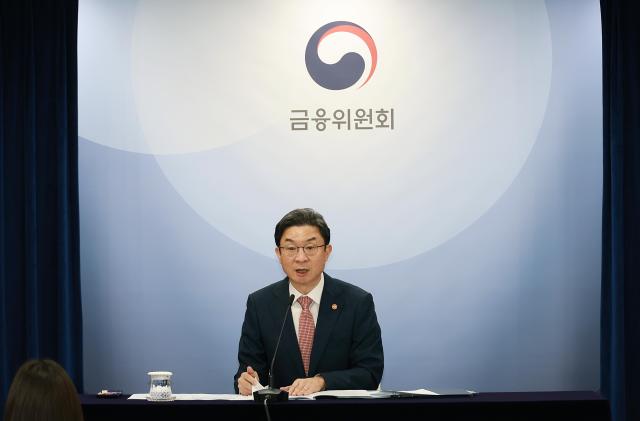
The Financial Services Commission (FSC) is set to implement a structural shift toward inclusive finance. This initiative follows President Lee Jae-myung's criticism of predatory lending practices and Policy Chief Kim Yong-beom's concerns regarding interest rate stratification and the exclusion of mid- and low-credit borrowers. The FSC has identified financial sector reform as a key priority for the second half of this year. To this end, Chairman Lee Ok-yeon proposed the 'Three-Tiered Inclusive Finance' model, aiming to address the systemic issues that push vulnerable borrowers into policy-backed microfinance and illegal lending.
◆ Lee Ok-yeon Proposes 'Three-Tiered Inclusive Finance'
During a press briefing on May 21, Chairman Lee outlined the 'Three-Tiered Inclusive Finance' model. The first tier consists of formal financial institutions such as banks and savings banks, the second tier includes policy-backed microfinance, and the third tier offers alternative recovery financing for borrowers who cannot be accommodated by the existing financial system. He noted that the first tier has failed to adequately manage risk, resulting in mid- and low-credit borrowers being pushed into the second and third tiers.
Lee explained that the role of financial institutions is to assess and manage risk, determining the future potential of borrowers. However, he pointed out that financial companies often gravitate toward the safest options, leading to a situation where vulnerable borrowers are not sufficiently absorbed by formal finance. This results in increased demand for policy-backed microfinance, which in turn cannot handle the overflow, forcing some borrowers into illegal lending.
The second tier, policy-backed microfinance, and the third tier, recovery financing, serve as safety nets for borrowers excluded from formal finance. However, as demand from the first tier grows, policy-backed microfinance must operate on a large-scale, standardized basis, limiting its ability to manage individual cases. Lee emphasized the need for a long-term financial approach that utilizes relaxed funding sources, such as donations, rather than traditional bank deposit-based loans, focusing on the potential for recovery over five to ten years rather than the likelihood of default within one year.
This movement by the financial authorities aligns with the concerns raised by the presidential office. President Lee Jae-myung recently stated, "Financial institutions are quasi-public entities, and inclusive finance is one of their obligations," urging action against predatory lending practices. Policy Chief Kim Yong-beom has also publicly addressed the limitations of the credit evaluation system and the issues of interest rate stratification and exclusion of mid- and low-credit borrowers. Amid the ongoing scrutiny of long-term debt collection practices, there is a growing recognition of the need to reform both conservative lending practices and the credit evaluation system within the financial sector.
◆ Expanding 'Korea Premium'
In conjunction with the shift toward inclusive finance, Chairman Lee also outlined plans for capital market globalization. While efforts have previously focused on eliminating the 'Korea Discount' in domestic markets, the aim is now to attract foreign investment into the domestic stock market, transforming it into a 'Korea Premium.' Lee stated, "We will actively pursue the globalization of capital markets to facilitate the influx of global funds and high-quality assets," noting that while foreign individual investors are interested in purchasing Korean stocks, the existing mechanisms are insufficient to accommodate this demand.
To facilitate this, the FSC plans to expand the scope of foreign integrated accounts from stocks to include exchange-traded funds (ETFs). The foreign integrated account system allows overseas investors to invest in the domestic stock market without needing to open separate accounts with domestic securities firms. Additionally, the government will host a large-scale overseas investor relations event named 'Korea Premium Week' in September, similar to Japan's 'Japan Week' and Taiwan's 'Taiwan Week.' This event aims to consolidate various overseas IR activities into a single international event representing the Korean capital market.
The FSC is also accelerating efforts to improve capital market regulations. It is preparing to implement a ban on duplicate listings by July. To this end, two seminars will be held this month, and a draft of detailed regulations and guidelines will be released by the end of May or early June. Furthermore, the FSC reiterated plans to ease network separation regulations for financial companies that possess a certain level of security capabilities and are willing to enhance security using artificial intelligence (AI). There is also a possibility of completely lifting network separation regulations for financial companies with advanced security capabilities and AI integration.
* This article has been translated by AI.
Copyright ⓒ Aju Press All rights reserved.