

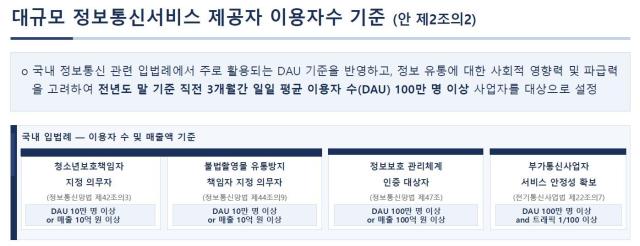
The Broadcasting and Media Commission (BMC) has unveiled a revised enforcement decree of the Information and Communications Network Act aimed at curbing the illegal distribution of false information. The key points of the revision include targeting platforms with an average daily user count (DAU) of over 1 million and specifying criteria for increased damages applicable to creators with over 100,000 subscribers.
On May 21, the BMC held a discussion on the revised enforcement decree at the Broadcasting Hall in Mokdong, Seoul, focusing on systematic responses to false information.
A major point of contention is the definition of a "large-scale information service provider." The BMC has set the threshold for regulation at platforms with a DAU of over 1 million in the past three months. Shin Young-kyu, head of the BMC's Broadcasting and Telecommunications User Policy Bureau, explained, "We chose DAU over monthly active users (MAU) due to its social impact and existing legislative precedents."
The regulation will apply to social networking services (SNS), online communities, video-sharing platforms, and open markets that facilitate information exchange among users. Shin noted, "Private conversations, such as KakaoTalk group chats, are not included, but open chat rooms are subject to regulation."
The criteria for increased damages will also be limited to revenue-generating information publishers with a certain level of influence. The enforcement decree defines those who earn income from delivering facts and opinions through advertisements or sponsorships and have posted information at least three times in the last three months. For SNS creators, including those on YouTube and Instagram, the threshold is set at 100,000 subscribers and a minimum of 100,000 views in the previous three months based on content virality standards.
Additionally, the role of the "Transparency Center," which is being promoted as a key support organization for responding to false information, was also a significant topic of discussion.
The BMC plans to operate the Transparency Center as a hub connecting the government, platforms, and fact-checking organizations. In line with the revised Information and Communications Network Act, the government will not directly assess the authenticity of posts or decide on their removal. Instead, the focus will be on supporting private fact-checking and platform self-regulation both technically and administratively.
The Transparency Center will also analyze "transparency reports." The BMC intends to review the number of reports and processing cases published by platforms, as well as the outcomes of appeals, to evaluate the effectiveness of responses to false information.
The BMC plans to gather public feedback on the legislative proposal until May 27, followed by regulatory review and committee approval in early to mid-June, with a goal of obtaining Cabinet approval by the end of June.
* This article has been translated by AI.
Copyright ⓒ Aju Press All rights reserved.