

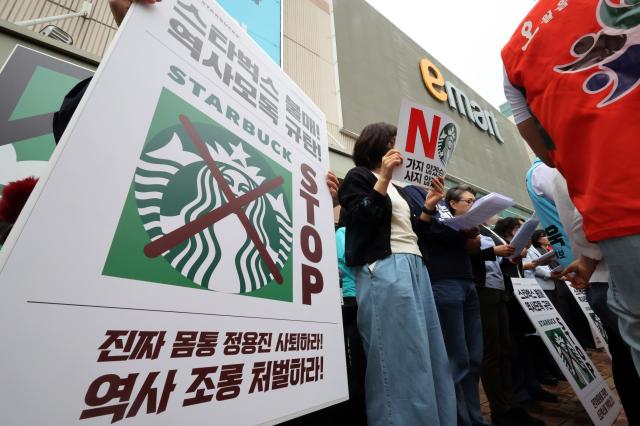
The controversy surrounding Starbucks Korea's "Tank Day" has escalated into a boycott movement, refund relays, and political and ideological disputes. Industry experts warn that this situation could undermine Starbucks' core competitive advantage, its loyal customer base, brand image, and overall revenue structure.
As of May 21, posts sharing methods for refunding Starbucks cards have rapidly spread across online communities and social media platforms. Some users have encouraged participation in the boycott by posting screenshots of their membership cancellation on the Starbucks app or refund certification photos. Videos showing users smashing Starbucks tumblers and mugs with hammers, dubbed "boycott certifications," have also emerged. Additionally, tips for covering or marking out the Starbucks logo on their products with stickers have been shared.
The backlash has reached the political arena and local communities, with criticism that Starbucks has belittled the May 18 Gwangju Democratization Movement. Within the Democratic Party, a directive has been issued to avoid entering Starbucks locations, and organized boycotts have begun in the Gwangju and Jeonnam regions among local governments and businesses. On May 21, the city of Gwangju released a statement declaring that it views the Starbucks Korea incident not merely as a mistake by a staff member but as a significant social disaster caused by a CEO lacking historical awareness. The city announced a ban on using Starbucks gift cards at various events it organizes. Gwangju Bank, which has previously distributed Starbucks products to thousands during major events like savings and card launches, has also announced a complete halt to its distribution of Starbucks products and mobile coupons.
Industry analysts are closely monitoring the potential impact of the boycott, refund requests, and app cancellations on Starbucks' customer retention structure, which has been crucial to its growth. Starbucks has employed a strategy that combines a prepaid charging system with a rewards program to keep loyal customers within its ecosystem. According to the Financial Supervisory Service's electronic disclosure system, SCK Company reported a record prepaid balance of 427.6 billion won at the end of last year, with total contractual liabilities, including unused reward points, reaching 454.3 billion won.
![Starbucks ownership structure [Graphic=Ajou Economic Art Team]](https://image.ajunews.com/content/image/2026/05/21/20260521202430992890.jpg)
However, the growth rate of prepaid balances has noticeably slowed due to intensified competition in the café industry. The growth rate for Starbucks' prepaid balance, which reached 19.1% in 2022, dropped to 8.2% last year. Analysts suggest that the rapid penetration of low-cost coffee brands into Starbucks' core market is diminishing its appeal to loyal customers. In this context, the possibility of accelerated customer attrition due to the current situation cannot be ruled out.
Above all, it seems inevitable that the brand's image will suffer. Some conservative online communities have referred to Starbucks as "Patriotbucks" and "Anti-Communist Café," launching a "support movement" alongside AI-generated images of former President Chun Doo-hwan. Concerns are rising that if the brand becomes a proxy in ideological conflicts, it could lead to a permanent loss of general customers.
There are also speculations that if the situation escalates into a political issue, Starbucks' headquarters in the U.S. may intervene directly. The company has emphasized its neutrality, stating on its official website that "Starbucks is not a political organization." If the headquarters does intervene, the call option clause in the equity agreement with Shinsegae Group could be triggered.
In July 2021, E-Mart acquired additional shares from Starbucks Coffee International (SCI), the U.S. parent company, and currently holds a 67.5% stake in Starbucks Korea. However, the call option held by the headquarters includes a clause that allows it to acquire all of E-Mart's shares at a 35% discount to fair value if the contract is terminated due to E-Mart's fault. If the headquarters were to reclaim management rights due to brand value deterioration, it could lose a key cash cow with annual sales of 3.238 trillion won, placing significant pressure on Shinsegae Group.
Lee Jong-woo, a professor of retail marketing at Namseoul University, stated, "It is quite dangerous for a consumer-facing brand to become embroiled in political controversies. There needs to be authentic actions that consumers can understand, such as supporting content related to democratic values or contributing to education, to turn the situation around."
* This article has been translated by AI.
Copyright ⓒ Aju Press All rights reserved.